- Complement F 79 Consider A Physical System Of Fixed Angular Momentum I Whose State Space Is E And Whose State Vector 1 (285.67 KiB) Viewed 50 times
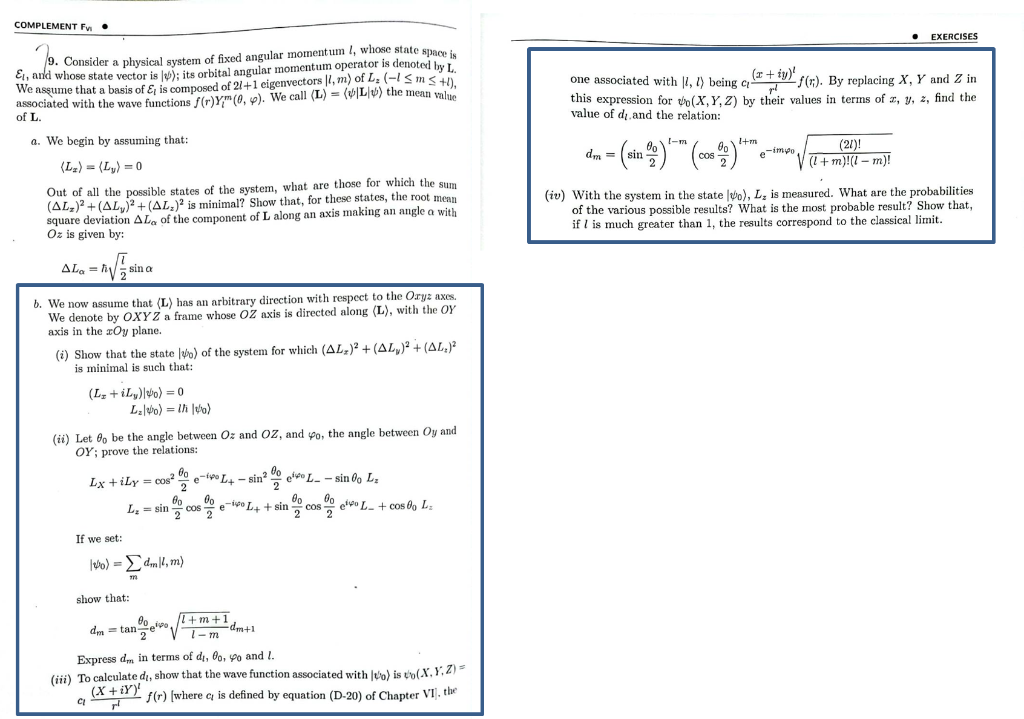
COMPLEMENT F 79. Consider a physical system of fixed angular momentum I, whose state space is E, and whose state vector is l); its orbital angular momentum operator is denoted by L We assume that a basis of & is composed of 21+1 eigenvectors , m) of L₂ (-1 ≤m≤ +1), associated with the wave functions f(r)Y (0, p). We call (L) = (L) the mean value of L. a. We begin by assuming that: {Lz)=(Lu)=0 Out of all the possible states of the system, what are those for which the sum (AL₂)²+(AL)² + (AL,)2 is minimal? Show that, for these states, the root mean square deviation ALa of the component of L along an axis making an angle a with Oz is given by: ALa = √√+sina F√√Si b. We now assume that (L) has an arbitrary direction with respect to the Oryz axes. We denote by OXYZ a frame whose OZ axis is directed along (L), with the OY axis in the Oy plane. (i) Show that the state o) of the system for which (AL)² + (AL)² + (AL)² is minimal is such that: (L₂ + iLy)|vo) = 0 L₂|0) = 10) (ii) Let o be the angle between Oz and OZ, and yo, the angle between Oy and OY; prove the relations: -sin² e-po % e L-sin 00 L₂ Lx+iLy = cos² Bo 00 00 L₂ = sin cose-L+ + sin cos e L_ + cos 0 L 2 l+m+1 dm = tane -dm+1 1-m Express dm in terms of di, 80, 9o and I. (iii) To calculated, show that the wave function associated with to) is vo(X,Y,Z) = (X+Y)¹ pl f(r) [where c, is defined by equation (D-20) of Chapter VII, the C₂ If we set: |vo) = Σdm|l, m) m show that: . EXERCISES (x+iy)! one associated with 1, l) being c+ f(r). By replacing X, Y and Z in this expression for o(X,Y,Z) by their values in terms of z, y, z, find the value of d, and the relation: 1+m = (sin %) - (cos %) ¹* e-impo, (21)! (l+m)!(l - m)! (iv) With the system in the state (vo), L₂ is measured. What are the probabilities of the various possible results? What is the most probable result? Show that, if I is much greater than 1, the results correspond to the classical limit.