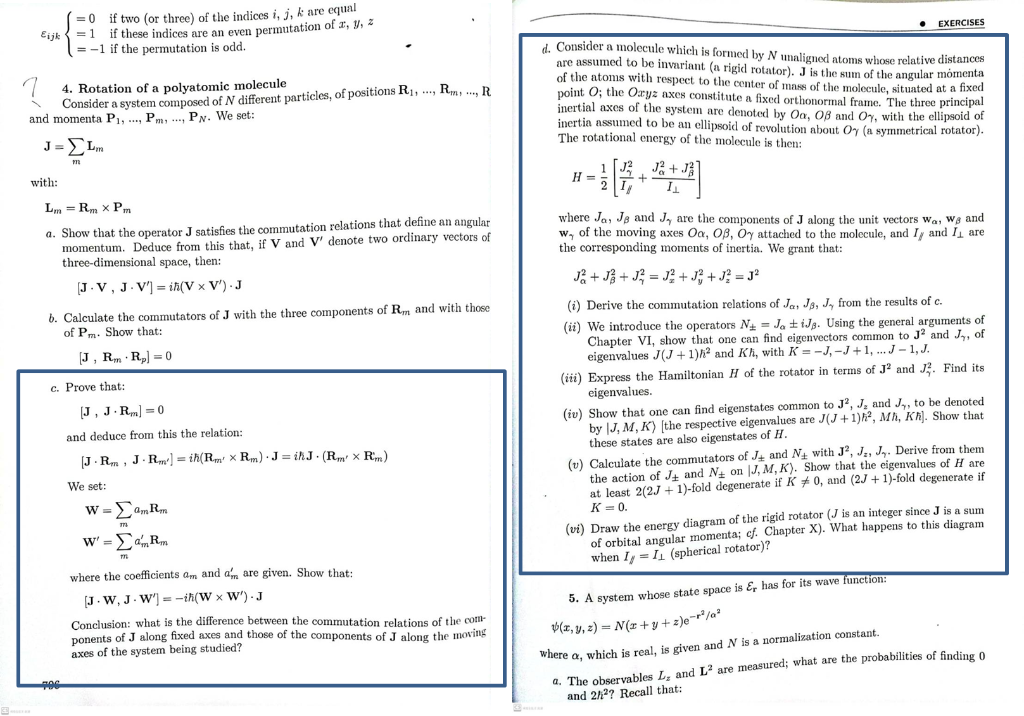
- 0 If Two Or Three Of The Indices I J K Are Equal Eijk 1 If These Indices Are An Even Permutation Of X Y Z 1 1 (409.16 KiB) Viewed 51 times
= 0 if two (or three) of the indices i, j, k are equal Eijk = 1 if these indices are an even permutation of x, y, z =-1 if the permutation is odd. 4. Rotation of a polyatomic molecule Consider a system composed of N different particles, of positions R₁,..., Rm..., R and momenta P₁, ..., Pm, PN. We set: J = =ΣLm m LmRm x Pm a. Show that the operator J satisfies the commutation relations that define an angular momentum. Deduce from this that, if V and V' denote two ordinary vectors of three-dimensional space, then: [J.V, J.V'] = iħ(V x V). J b. Calculate the commutators of J with the three components of Rm and with those of Pm. Show that: [J, Rm Rp] = 0 [J, J.Rm] =0 and deduce from this the relation: [J.Rm, J.Rm'] = ih(Rm' x Rm). JikJ (Rm x Rm) We set: W = Σam Rm m W' =ΣamRm m where the coefficients am and am are given. Show that: [J. W, J.W] =-ih(W x W') - J Conclusion: what the difference between the commutation relations of the com ponents of J along fixed axes and those of the components of J along the moving axes of the system being studied? with: c. Prove that: EXERCISES d. Consider a molecule which is formed by are assumed to be invariant (a rigid rotator). J is the sum of the angular momenta unaligned atoms whose relative distances of the atoms with respect to the center of mass of the molecule, situated at a fixed point O; the Oryz axes constitute a fixed orthonormal frame. The three principal inertial axes of the system are denoted by Oa, 08 and Oy, with the ellipsoid of inertia assumed to be an ellipsoid of revolution about Oy (a symmetrical rotator). The rotational energy of the molecule is then: H == J²+ + where Ja, Ja and J, are the components of J along the unit vectors Wa, Wa and w, of the moving axes Oa, Oß, Oy attached to the molecule, and I and I are the corresponding moments of inertia. We grant that: J²+J+J² J² + 3² +J² = 3² (i) Derive the commutation relations of Ja, Ja, J, from the results of c. (ii) We introduce the operators N₁ = Ja tiJg. Using the general arguments of Chapter VI, show that one can find eigenvectors common to J2 and J,, of eigenvalues J(J+1)h² and Kh, with K-J,-J+1,...J-1, J. (iii) Express the Hamiltonian H of the rotator in terms of J2 and J. Find its eigenvalues. (iv) Show that one can find eigenstates common to J2, J, and J,, to be denoted by J, M, K) [the respective eigenvalues are J(J+1)h², Mh, Kh). Show that these states are also eigenstates of H. (v) Calculate the commutators of J+ and N₁ with J2, J₂, J. Derive from them the action of J+ and N on J, M, K). Show that the eigenvalues of are at least 2(2J+1)-fold degenerate if K0, and (2J+1)-fold degenerate if K = 0. (vi) Draw the energy diagram of the rigid rotator (J is an integer since J is a sum of orbital angular momenta; cf. Chapter X). What happens to this diagram when I = I₁ (spherical rotator)? 5. A system whose state space is Er has for its wave function: (x, y, z) = N(x+y+z)e=r² /a² where a, which is real, is given and N is a normalization constant. a. The observables L. and L² are measured; what are the probabilities of finding 0 and 2/2? Recall that: