Page 1 of 1
C.3 1 2 3 4 1 1 1 1 1 a) The Fresnel amplitude for reflection of light travel- ling (at normal incidence) from medium 1
Posted: Wed May 04, 2022 1:19 pm
by answerhappygod
- C 3 1 2 3 4 1 1 1 1 1 A The Fresnel Amplitude For Reflection Of Light Travel Ling At Normal Incidence From Medium 1 1 (130.16 KiB) Viewed 40 times
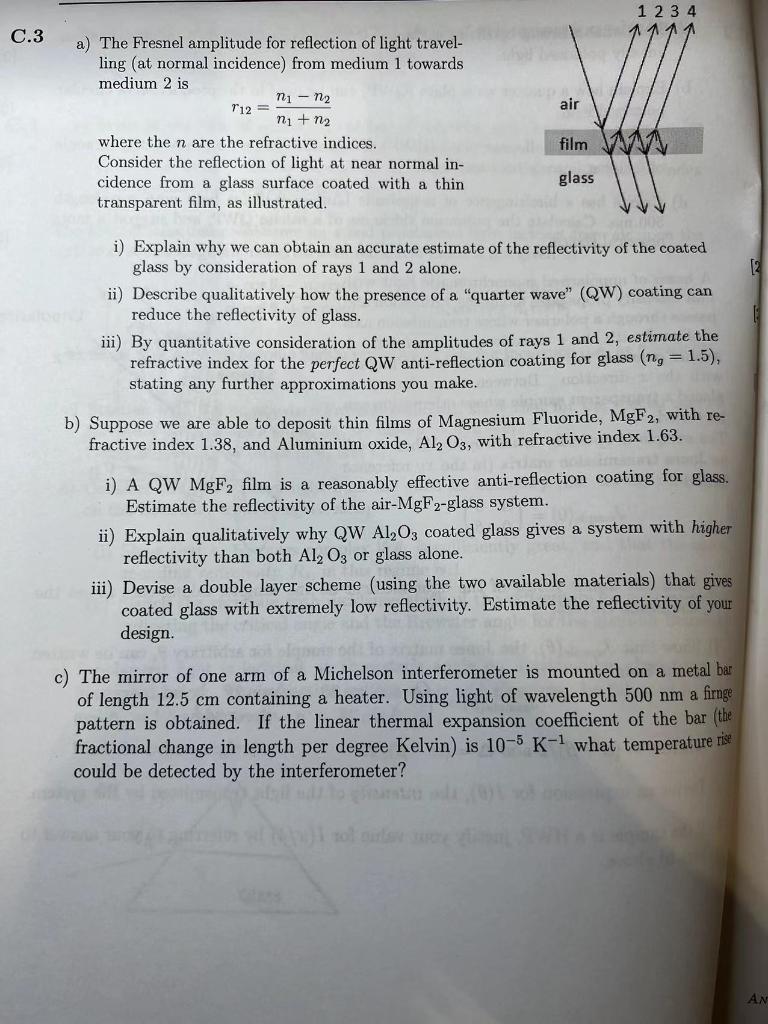
C.3 1 2 3 4 1 1 1 1 1 a) The Fresnel amplitude for reflection of light travel- ling (at normal incidence) from medium 1 towards medium 2 is n1n₂ 712= air n₁ + n₂ where the n are the refractive indices. film Consider the reflection of light at near normal in- cidence from a glass surface coated with a thin transparent film, as illustrated. glass i) Explain why we can obtain an accurate estimate of the reflectivity of the coated glass by consideration of rays 1 and 2 alone. [2 ii) Describe qualitatively how the presence of a "quarter wave" (QW) coating can reduce the reflectivity of glass. iii) By quantitative consideration of the amplitudes of rays 1 and 2, estimate the refractive index for the perfect QW anti-reflection coating for glass (ng= 1.5), stating any further approximations you make. b) Suppose we are able to deposit thin films of Magnesium Fluoride, MgF2, with re- fractive index 1.38, and Aluminium oxide, Al2 O3, with refractive index 1.63. i) A QW MgF2 film is a reasonably effective anti-reflection coating for glass. Estimate the reflectivity of the air-MgF2-glass system. ii) Explain qualitatively why QW Al2O3 coated glass gives a system with higher reflectivity than both Al2 O3 or glass alone. iii) Devise a double layer scheme (using the two available materials) that gives coated glass with extremely low reflectivity. Estimate the reflectivity of your design. c) The mirror of one arm of a Michelson interferometer is mounted on a metal bar of length 12.5 cm containing a heater. Using light of wavelength 500 nm a firnge pattern is obtained. If the linear thermal expansion coefficient of the bar (the fractional change in length per degree Kelvin) is 10-5 K-1 what temperature rise could be detected by the interferometer? AN