Page 1 of 1
and Health Physics PRH 363 Radiation Detection and Instruments Academic year: 2020 semester 2 1. A GM detector having an
Posted: Wed May 04, 2022 1:09 pm
by answerhappygod
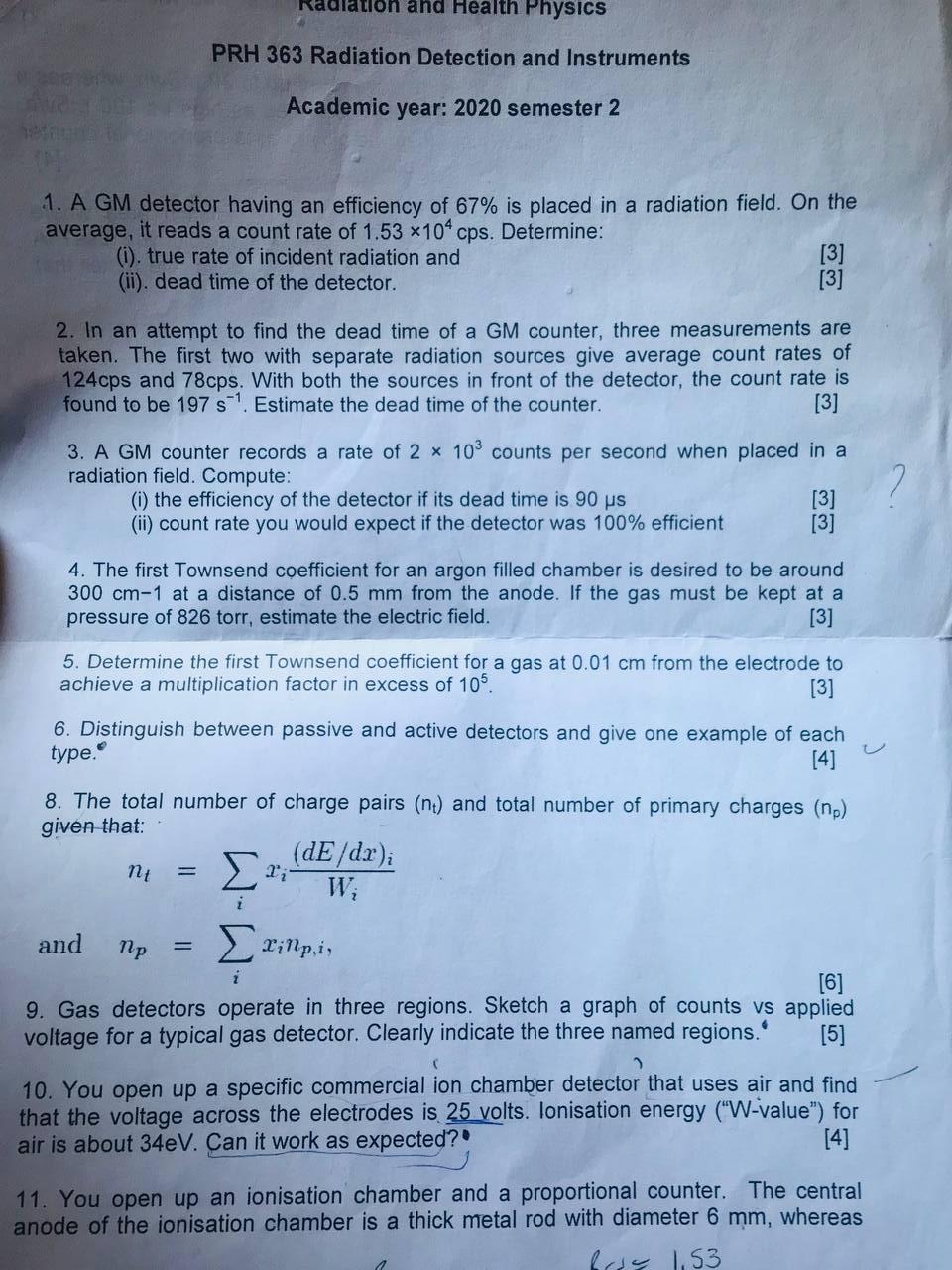
- And Health Physics Prh 363 Radiation Detection And Instruments Academic Year 2020 Semester 2 1 A Gm Detector Having An 1 (177.55 KiB) Viewed 44 times
and Health Physics PRH 363 Radiation Detection and Instruments Academic year: 2020 semester 2 1. A GM detector having an efficiency of 67% is placed in a radiation field. On the average, it reads a count rate of 1.53 x10 cps. Determine: (i). true rate of incident radiation and [3] [3] (ii). dead time of the detector. 2. In an attempt to find the dead time of a GM counter, three measurements are taken. The first two with separate radiation sources give average count rates of 124cps and 78cps. With both the sources in front of the detector, the count rate is found to be 197 s¹. Estimate the dead time of the counter. [3] 3. A GM counter records a rate of 2 x 10³ counts per second when placed in a radiation field. Compute: ? (i) the efficiency of the detector if its dead time is 90 µs [3] [3] (ii) count rate you would expect if the detector was 100% efficient 4. The first Townsend coefficient for an argon filled chamber is desired to be around 300 cm-1 at a distance of 0.5 mm from the anode. If the gas must be kept at a pressure of 826 torr, estimate the electric field. [3] 5. Determine the first Townsend coefficient for a gas at 0.01 cm from the electrode to achieve a multiplication factor in excess of 105. [3] 6. Distinguish between passive and active detectors and give one example of each type. [4] 8. The total number of charge pairs (n) and total number of primary charges (np) given that: nt = Σ l'i (dE/dx); W₁ i and np = Σxinp,i, i [6] 9. Gas detectors operate in three regions. Sketch a graph of counts vs applied voltage for a typical gas detector. Clearly indicate the three named regions." [5] 2 10. You open up a specific commercial ion chamber detector that uses air and find that the voltage across the electrodes is 25 volts. Ionisation energy ("W-value") for air is about 34eV. Can it work as expected? [4] 11. You open up an ionisation chamber and a proportional counter. The central anode of the ionisation chamber is a thick metal rod with diameter 6 mm, whereas fra 1,53 a