Page 1 of 1
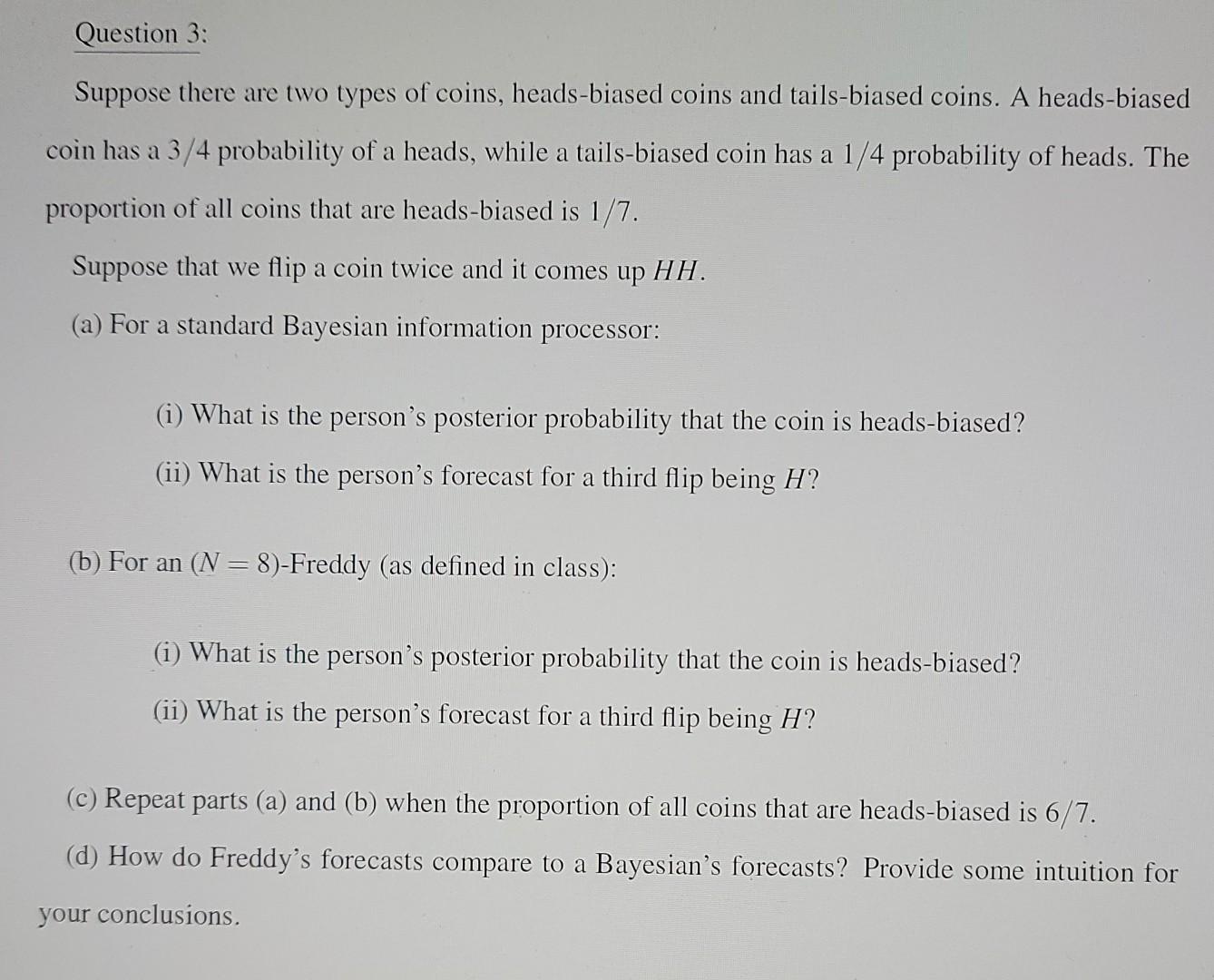
Question 3: Suppose there are two types of coins, heads-biased coins and tails-biased coins. A heads-biased coin has a 3
Posted: Wed May 04, 2022 1:02 pm
by answerhappygod
- Question 3 Suppose There Are Two Types Of Coins Heads Biased Coins And Tails Biased Coins A Heads Biased Coin Has A 3 1 (135.35 KiB) Viewed 34 times
Question 3: Suppose there are two types of coins, heads-biased coins and tails-biased coins. A heads-biased coin has a 3/4 probability of a heads, while a tails-biased coin has a 1/4 probability of heads. The proportion of all coins that are heads-biased is 1/7. Suppose that we flip a coin twice and it comes up HH. (a) For a standard Bayesian information processor: (i) What is the person's posterior probability that the coin is heads-biased? (ii) What is the person's forecast for a third flip being H? (b) For an (N = 8)-Freddy (as defined in class): (i) What is the person's posterior probability that the coin is heads-biased? (ii) What is the person's forecast for a third flip being H? (c) Repeat parts (a) and (b) when the proportion of all coins that are heads-biased is 6/7. (d) How do Freddy's forecasts compare to a Bayesian's forecasts? Provide some intuition for your conclusions.