Page 1 of 1
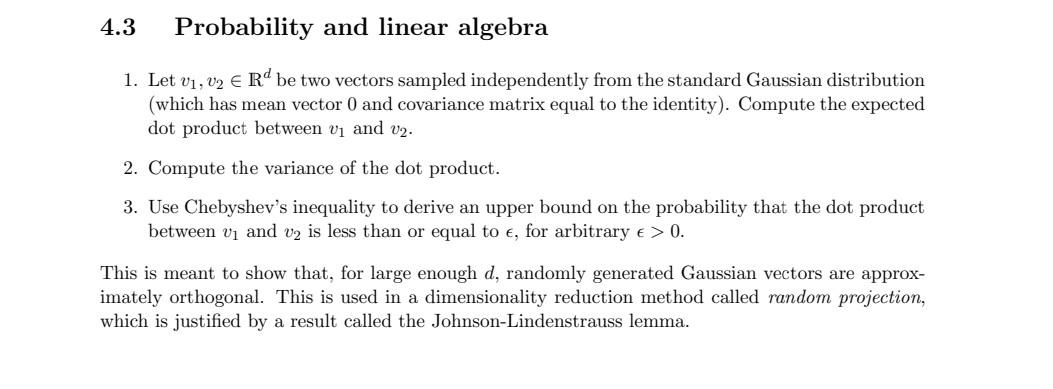
4.3 Probability and linear algebra 1. Let v₁, v2 € Rd be two vectors sampled independently from the standard Gaussian di
Posted: Wed May 04, 2022 12:00 pm
by answerhappygod
- 4 3 Probability And Linear Algebra 1 Let V V2 Rd Be Two Vectors Sampled Independently From The Standard Gaussian Di 1 (51.71 KiB) Viewed 43 times
4.3 Probability and linear algebra 1. Let v₁, v2 € Rd be two vectors sampled independently from the standard Gaussian distribution (which has mean vector 0 and covariance matrix equal to the identity). Compute the expected dot product between ₁ and v₂. 2. Compute the variance of the dot product. 3. Use Chebyshev's inequality to derive an upper bound on the probability that the dot product between ₁ and 2 is less than or equal to e, for arbitrary € > 0. This is meant to show that, for large enough d, randomly generated Gaussian vectors are approx- imately orthogonal. This is used in a dimensionality reduction method called random projection, which is justified by a result called the Johnson-Lindenstrauss lemma.