- 3 Consider A Pure Birth Process X T T 0 In Which Each Member Of The Population Gives Birth To A New Member At Rate 1 (62.13 KiB) Viewed 23 times
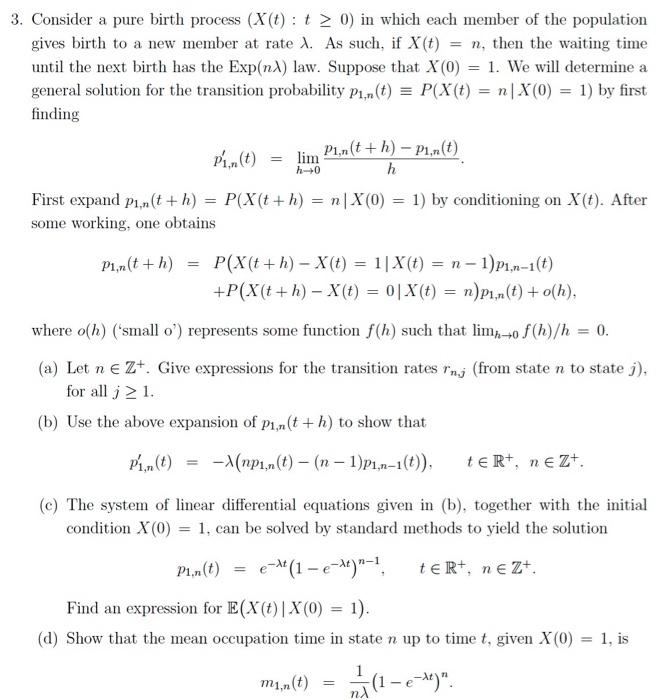
3. Consider a pure birth process (X(t): t≥ 0) in which each member of the population gives birth to a new member at rate X. As such, if X(t) = n, then the waiting time until the next birth has the Exp(nλ) law. Suppose that X(0) = 1. We will determine a general solution for the transition probability P1,n(t) = P(X(t) = n | X(0) = 1) by first finding P1,n (t) = lim P1,n(t+h)-P1,n(t) h h→0 = P(X(t + h) = n | X(0) = 1) by conditioning on X(t). After First expand p1,n (t + h) some working, one obtains P1,n (t + h) = P(X(t+h)-X(t) = 1|X(t) = n − 1)P1,n-1(t) - +P(X(t+h)- X(t) = 0|X(t) = n)Pin(t) +o(h), where o(h) ('small o') represents some function f(h) such that lim o f(h)/h = 0. (a) Let n € Z+. Give expressions for the transition rates rj (from state n to state j), for all > 1. (b) Use the above expansion of p1,n(t + h) to show that P₁,n(t) = -X(np1,n(t)-(n-1)pin-1(t)), te R¹, n € Z+. (c) The system of linear differential equations given in (b), together with the initial condition X(0) = 1, can be solved by standard methods to yield the solution P1,n(t) = e-xt (1-e-xt)"-1, teR+, ne Zt. Find an expression for E(X(t) | X(0) = 1). (d) Show that the mean occupation time in state n up to time t, given X(0) = 1, is m1,n(t) = (1-ext)". ηλ