Page 1 of 1
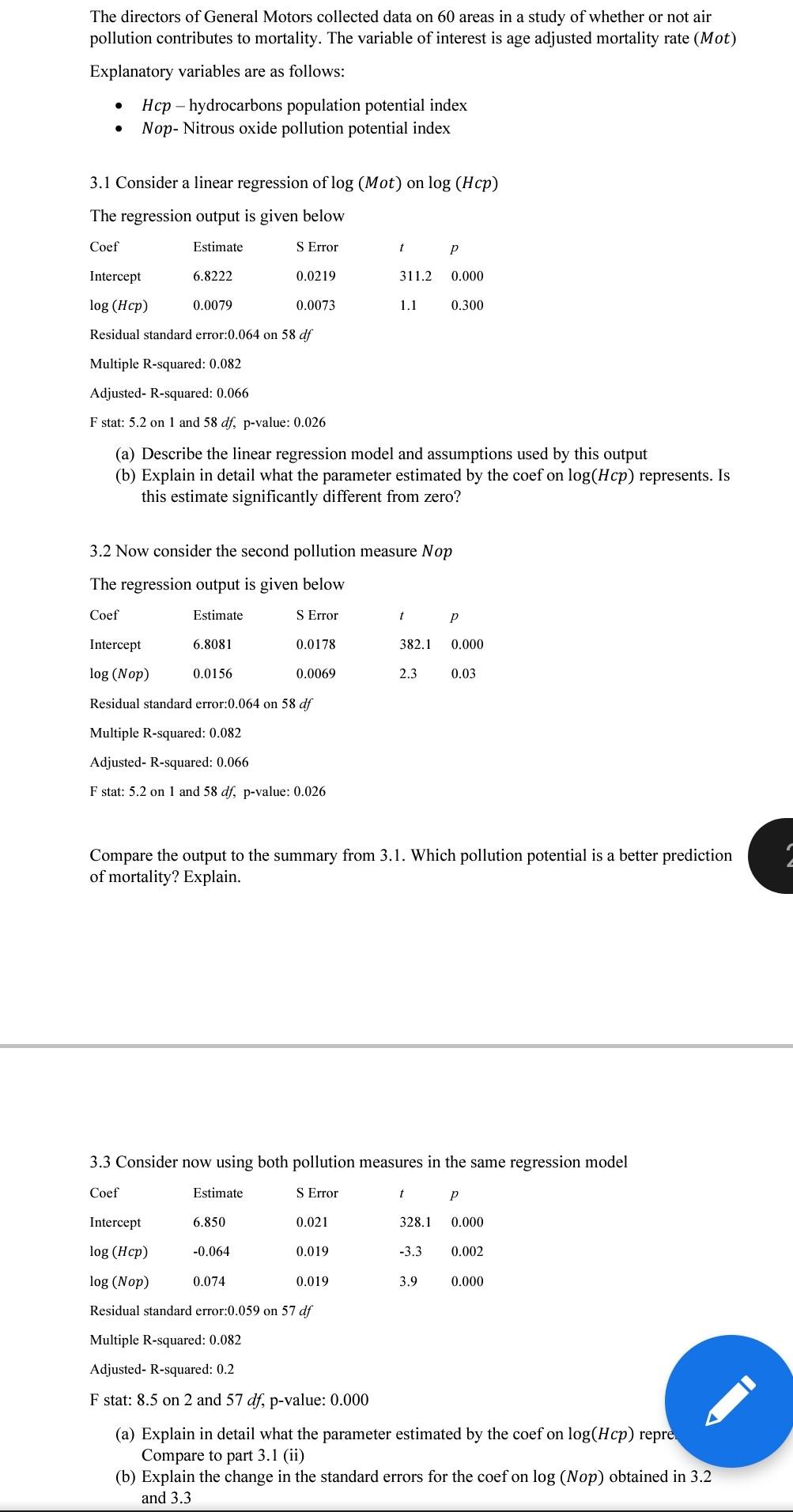
The directors of General Motors collected data on 60 areas in a study of whether or not air pollution contributes to mor
Posted: Wed May 04, 2022 11:54 am
by answerhappygod
- The Directors Of General Motors Collected Data On 60 Areas In A Study Of Whether Or Not Air Pollution Contributes To Mor 1 (170.43 KiB) Viewed 26 times
The directors of General Motors collected data on 60 areas in a study of whether or not air pollution contributes to mortality. The variable of interest is age adjusted mortality rate (Mot) Explanatory variables are as follows: ● Hcp-hydrocarbons population potential index ● Nop- Nitrous oxide pollution potential index 3.1 Consider a linear regression of log (Mot) on log (Hcp) The regression output is given below Coef Estimate S Error t Р Intercept 6.8222 0.0219 311.2 0.000 log (Hcp) 0.0079 0.0073 1.1 0.300 Residual standard error:0.064 on 58 df Multiple R-squared: 0.082 Adjusted- R-squared: 0.066 F stat: 5.2 on 1 and 58 df, p-value: 0.026 (a) Describe the linear regression model and assumptions used by this output (b) Explain in detail what the parameter estimated by the coef on log(Hcp) represents. Is this estimate significantly different from zero? 3.2 Now consider the second pollution measure Nop The regression output is given below Coef Estimate S Error P Intercept 6.8081 0.0178 382.1 0.000 log (Nop) 0.0156 0.0069 2.3 0.03 Residual standard error:0.064 on 58 df Multiple R-squared: 0.082 Adjusted- R-squared: 0.066 F stat: 5.2 on 1 and 58 df, p-value: 0.026 Compare the output to the summary from 3.1. Which pollution potential is a better prediction of mortality? Explain. 3.3 Consider now using both pollution measures in the same regression model Coef Estimate S Error t p Intercept 6.850 0.021 328.1 0.000 log (Hcp) -0.064 0.019 -3.3 0.002 log (Nop) 0.074 0.019 3.9 0.000 Residual standard error:0.059 on 57 df Multiple R-squared: 0.082 Adjusted- R-squared: 0.2 F stat: 8.5 on 2 and 57 df, p-value: 0.000 (a) Explain in detail what the parameter estimated by the coef on log(Hcp) repre Compare to part 3.1 (ii) (b) Explain the change in the standard errors for the coef on log (Nop) obtained in 3.2 and 3.3