Page 1 of 1
Instruction: Step 1: Go to "File" at the top left, click "make a copy." Step 2: Type in your answers on your own copy. S
Posted: Wed May 04, 2022 11:53 am
by answerhappygod
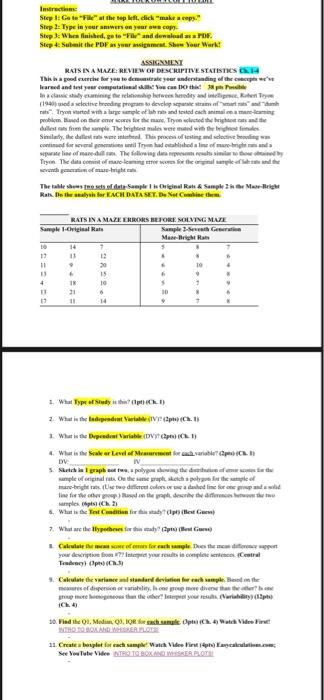
- Instruction Step 1 Go To File At The Top Left Click Make A Copy Step 2 Type In Your Answers On Your Own Copy S 1 (38.19 KiB) Viewed 23 times
Instruction: Step 1: Go to "File" at the top left, click "make a copy." Step 2: Type in your answers on your own copy. Step 3: When finished, go to "Fir" and download as a PDF. Step 4: Submit the PDF as your assignment Show Your Work! ASSIGNMENT RATS IN A MAZE: REVIEW OF DESCRIPTIVE STATISTICS C This is a good exercise for you to demonstrate your understanding of the concepts we've learned and test your computational skills You can Do this pl In a classic study examining the relationship between heredity and intelligence, Robert Try (1940) used a selective breeding program to develop separate strains of art and "dum nats" Tryon started with a large sample of lab rats and tested cach animalmaning problem. Based on their r scores es for the mare, Tryon selected the brightestats and the dullest rats from the sample. The brightest males were s ere mated with the brighned females Similarly, the challest rats were intabend. This process of testing and selective bling was continued for several generations until Tryn had established a line of mare-bright and separate line of mare dalla The following data represent results similar to those obtained by Tryon. The data consist of mare-leaming or scores for the original sample of seventh generation of mare-bright and the The table shows two sets of deta-Sample 1 is Original Rats & Sample 2 is the Maze-Bright Rats. In the analysis for EACH DATA SET. Do Not Combine them RATS IN A MAZE ERRORS BEFORE SOLVING MAZE Sample 1-Original Rats Sample 2-Seventh Generation Maze-Bright Ra 16 14 7 17 13 13 S 8 12 15 4 9 6 18: 11 21 6 17 11 14 9 1. What Type of Study is this? (1pt) (Ch. 1) 2. What is the Independent Variable (TV) (2pt) (Ch. 1) 1. What is the Dependent Variable (DV) (2p0) (Ch. 1) 4. What is the Scale or Level of Measurement for a variable? (C) DV 5. Sketch in 1 graph not res, a polygos showing the dead of a st sample of original rats. On the same graph, sketch a polygon for the sample of man-bright rats (se two different colors or use a deshed line for one group and d line for the other group) Based on the graph describe the differences samples. (pt) (Ch. 2) the wo 6. What is the Test Condition for this stady? (pt) (Best Gues) 7. What are the Hypotheses for this mady? (2p) (Best Ga 1. Calculate the main score of omes for each sample. Does the mean difference p your description from #77 Interpret your results in complete sentences (Central Tendency) Opt) (Ch.3) on the 9. Calculate the variance and standard deviation for each sample mures of dispersion or variability, Is one group more diverse than the other ne group more than the other? Isterpist your re (Variability) (12) (Ch. 4) 10. Find the Q1, Media Q, IQR for each sample Opt) (Ch. 4) Watch Video Find INTHO TO BOX AND WERPLOT 11. Create a boxplet for each sample Watch Video First (pt) Easycalculations.com See YouTube Video NTRO TO BOX AND WHISKER PLOTE 10 10