Page 1 of 1
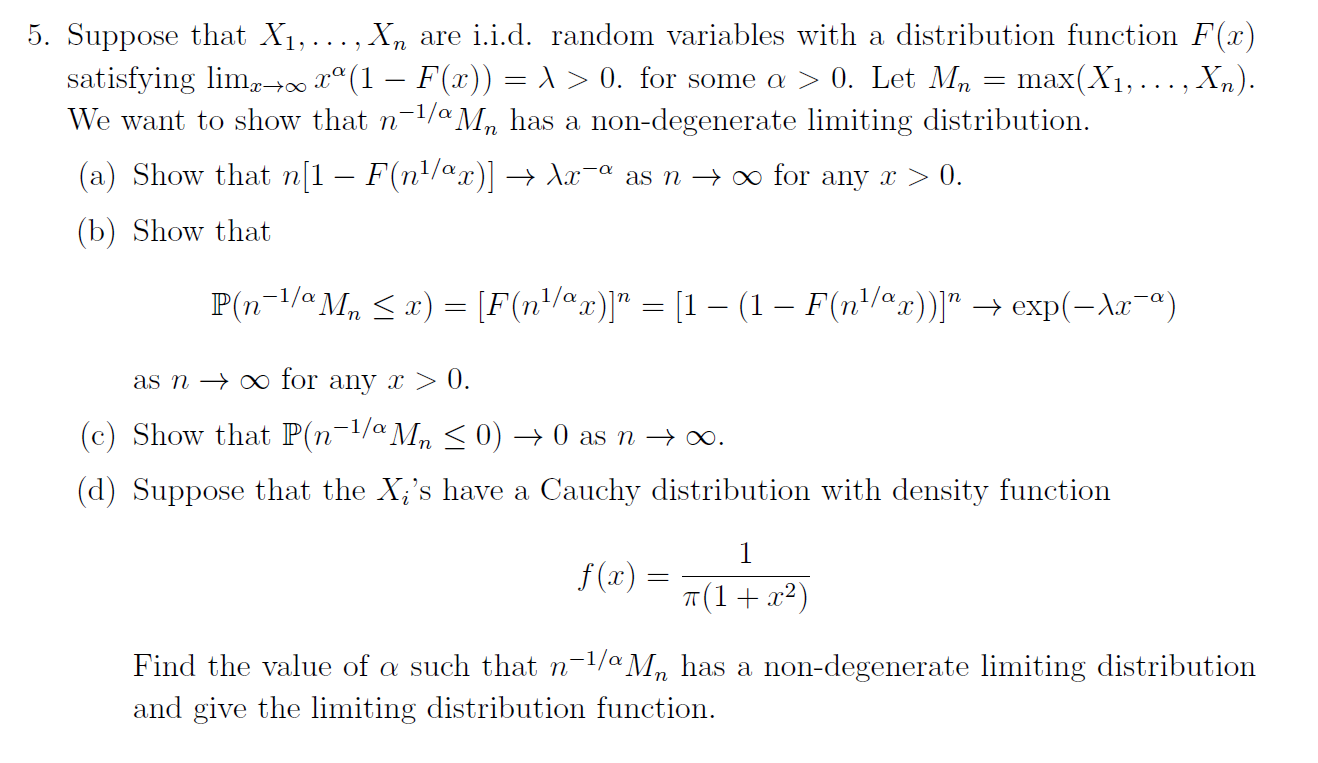
5. Suppose that X₁,..., Xn are i.i.d. random variables with a distribution function F(x) satisfying limä→∞ xª (1 − F(x))
Posted: Wed May 04, 2022 11:53 am
by answerhappygod
- 5 Suppose That X Xn Are I I D Random Variables With A Distribution Function F X Satisfying Lima Xa 1 F X 1 (111.84 KiB) Viewed 24 times
5. Suppose that X₁,..., Xn are i.i.d. random variables with a distribution function F(x) satisfying limä→∞ xª (1 − F(x)) = \ > 0. for some a > 0. Let M₂ = max(X₁, … , Xn). We want to show that n-¹/ªMn has a non-degenerate limiting distribution. a Show that n[1- F(n¹/ax)] → Axª as n → ∞ for any x > 0. (b) Show that P(n¯¹/ªM₁ ≤ x) = [F(n¹⁰x)]” = [1 − (1 − F(n¹/ªx))]″ → exp(-\ﯪ) as n→ ∞ for any x > 0. (c) Show that P(n−¹/a Mn ≤ 0) → 0 as n →∞. -1/a (d) Suppose that the X;'s have a Cauchy distribution with density function 1 f(x) π(1+x²) Find the value of a such that n-1/a Mn has a non-degenerate limiting distribution and give the limiting distribution function.