Page 1 of 1
4. (16 marks) Consider the quadratic function f: R → R given by f(x) = (x - 2)² + 3. For this question, you must fully j
Posted: Wed May 04, 2022 10:53 am
by answerhappygod
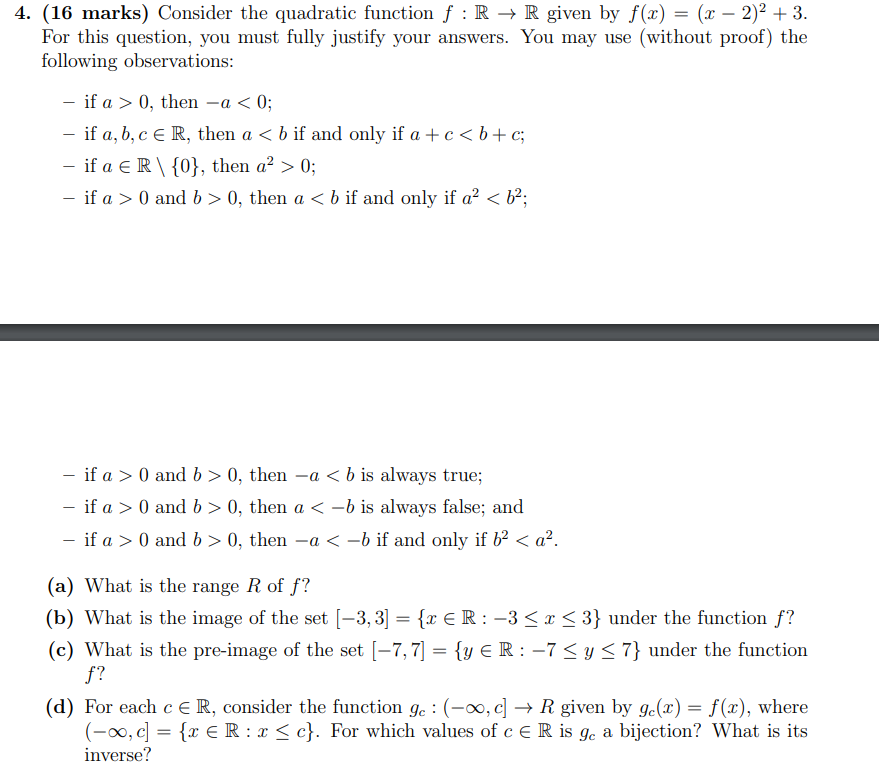
- 4 16 Marks Consider The Quadratic Function F R R Given By F X X 2 3 For This Question You Must Fully J 1 (114.53 KiB) Viewed 91 times
4. (16 marks) Consider the quadratic function f: R → R given by f(x) = (x - 2)² + 3. For this question, you must fully justify your answers. You may use (without proof) the following observations: if a > 0, then -a < 0; - if a, b, c = R, then a < b if and only if a + c <b+c; - if a € R \ {0}, then a² > 0; if a > 0 and b>0, then a < b if and only if a² <b²; - if a > 0 and b>0, then -a < b is always true; − if a > 0 and b > 0, then a < −b is always false; and - – if a > 0 and b>0, then −a < −b if and only if b² <a². (a) What is the range R of f? (b) What is the image of the set [-3, 3] = {x € R: -3 ≤ x ≤ 3} under the function f? (c) What is the pre-image of the set [-7,7] = {y € R: -7 ≤ y ≤ 7} under the function f? (d) For each c ER, consider the function ge : (-∞, c] → R given by ge(x) = f(x), where (-∞, c] = {x € R:x≤c}. For which values of c ER is ge a bijection? What is its inverse?