Page 1 of 1
Case A Case B 3. Two circular disks have the same radius and uniformly distributed mass and each carry the same total ch
Posted: Mon May 02, 2022 9:21 pm
by answerhappygod
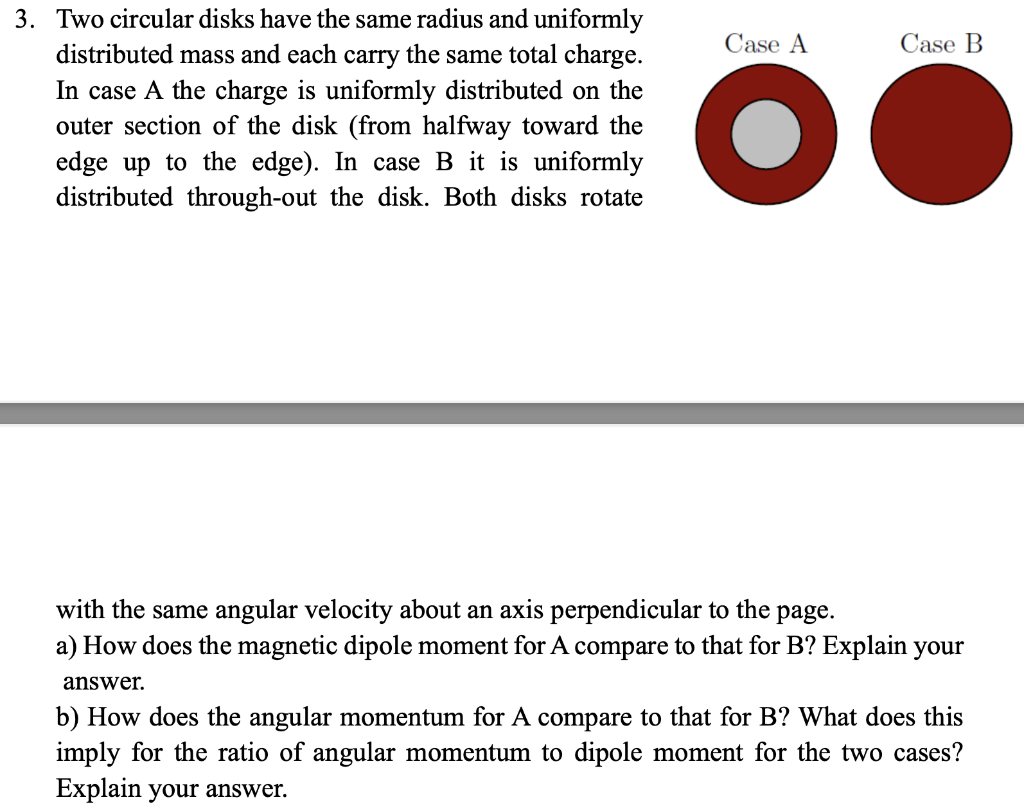
- Case A Case B 3 Two Circular Disks Have The Same Radius And Uniformly Distributed Mass And Each Carry The Same Total Ch 1 (141.7 KiB) Viewed 28 times
Case A Case B 3. Two circular disks have the same radius and uniformly distributed mass and each carry the same total charge. In case A the charge is uniformly distributed on the outer section of the disk (from halfway toward the edge up to the edge). In case B it is uniformly distributed through-out the disk. Both disks rotate with the same angular velocity about an axis perpendicular to the page. a) How does the magnetic dipole moment for A compare to that for B? Explain your answer. b) How does the angular momentum for A compare to that for B? What does this imply for the ratio of angular momentum to dipole moment for the two cases? Explain your answer.