Page 1 of 1
An airplane flies horizontally at an altitude of 1600 m. A sky-diver falls from the plane, starting at rest vertically (
Posted: Mon May 02, 2022 8:49 pm
by answerhappygod
- An Airplane Flies Horizontally At An Altitude Of 1600 M A Sky Diver Falls From The Plane Starting At Rest Vertically 1 (146.38 KiB) Viewed 29 times
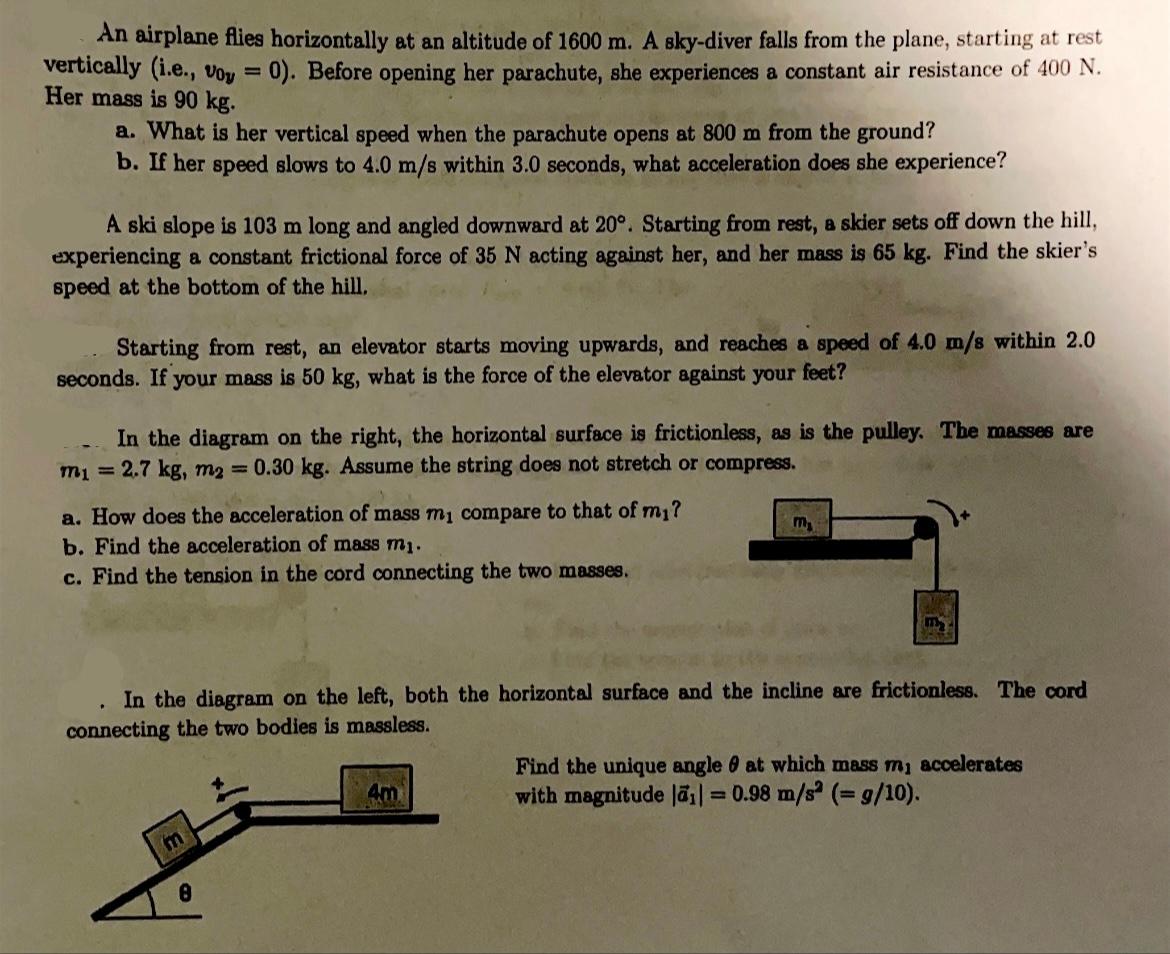
An airplane flies horizontally at an altitude of 1600 m. A sky-diver falls from the plane, starting at rest vertically (i.e., voy = 0). Before opening her parachute, she experiences a constant air resistance of 400 N. Her mass is 90 kg. a. What is her vertical speed when the parachute opens at 800 m from the ground? b. If her speed slows to 4.0 m/s within 3.0 seconds, what acceleration does she experience? A ski slope is 103 m long and angled downward at 20°. Starting from rest, a skier sets off down the hill, experiencing a constant frictional force of 35 N acting against her, and her mass is 65 kg. Find the skier's speed at the bottom of the hill. Starting from rest, an elevator starts moving upwards, and reaches a speed of 4.0 m/s within 2.0 seconds. If your mass is 50 kg, what is the force of the elevator against your feet? In the diagram on the right, the horizontal surface is frictionless, as is the pulley. The masses are mi = 2.7 kg, m2 = 0.30 kg. Assume the string does not ch or compress. a. How does the acceleration of mass my compare to that of mı? m b. Find the acceleration of mass mi. c. Find the tension in the cord connecting the two masses. In the diagram on the left, both the horizontal surface and the incline are frictionless. The cord connecting the two bodies is massless. Am Find the unique angle 8 at which mass m, accelerates with magnitude lä:) = 0.98 m/s (=9/10). m