Page 1 of 1
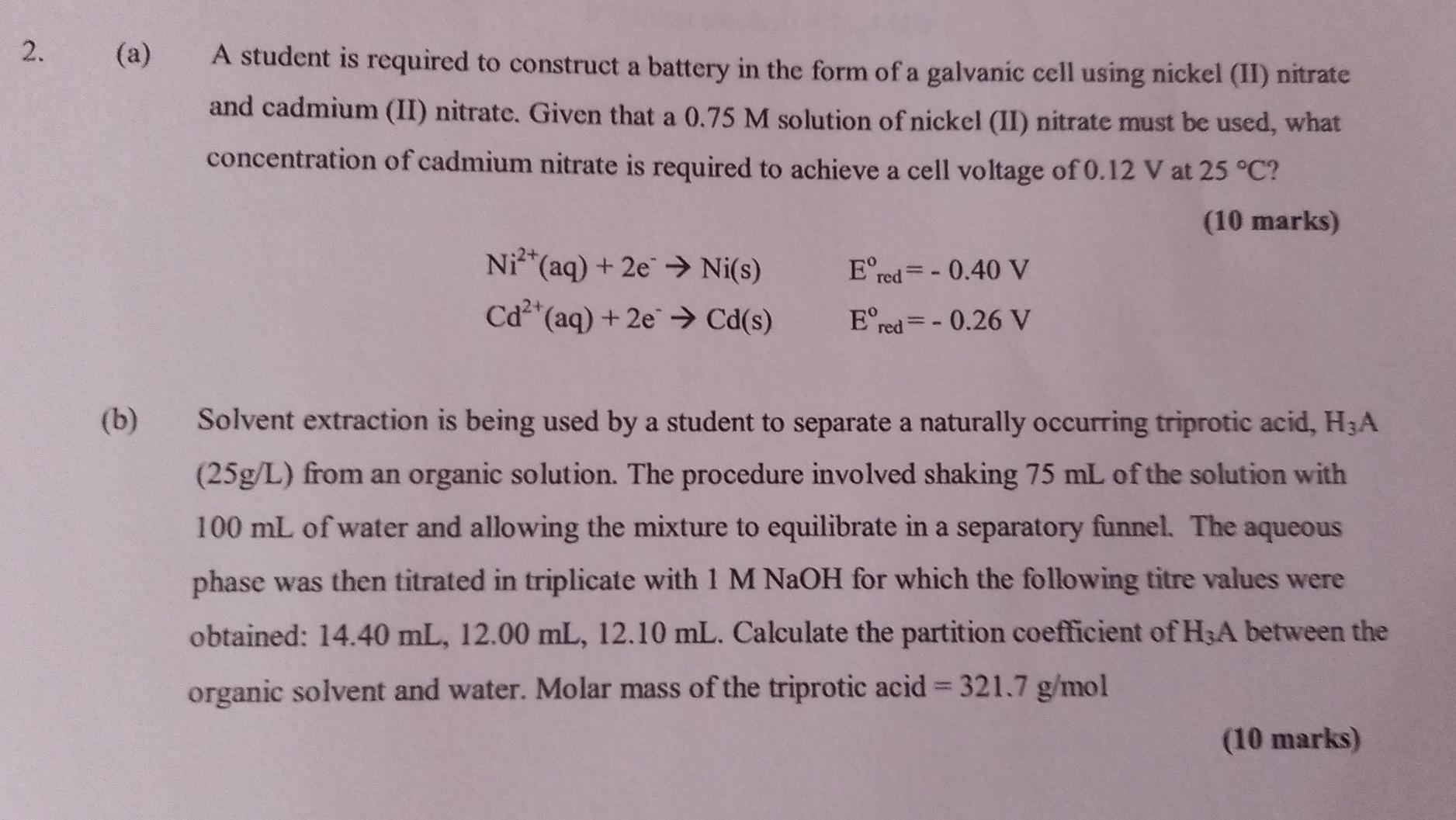
2. (a) A student is required to construct a battery in the form of a galvanic cell using nickel (II) nitrate and cadmium
Posted: Mon May 02, 2022 7:46 pm
by answerhappygod
- 2 A A Student Is Required To Construct A Battery In The Form Of A Galvanic Cell Using Nickel Ii Nitrate And Cadmium 1 (192.94 KiB) Viewed 22 times
2. (a) A student is required to construct a battery in the form of a galvanic cell using nickel (II) nitrate and cadmium (II) nitrate. Given that a 0.75 M solution of nickel (II) nitrate must be used, what concentration of cadmium nitrate is required to achieve a cell voltage of 0.12 V at 25 °C? (10 marks) Ni2+ (aq) + 2e → Ni(s) Ered= -0.40 V Cd²+ (aq) + 2e → Cd(s) Ered=-0.26 V (b) Solvent extraction is being used by a student to separate a naturally occurring triprotic acid, H3A (25g/L) from an organic solution. The procedure involved shaking 75 mL of the solution with 100 mL of water and allowing the mixture to equilibrate in a separatory funnel. The aqueous phase was then titrated in triplicate with 1 M NaOH for which the following titre values were obtained: 14.40 mL, 12.00 mL, 12.10 mL. Calculate the partition coefficient of H3A between the organic solvent and water. Molar mass of the triprotic acid = 321.7 g/mol (10 marks)