Page 1 of 1
B The Phase Line Sketching the direction field of a differential equation dy/dt = f(t, y) is particularly easy when the
Posted: Mon May 02, 2022 5:21 pm
by answerhappygod
- B The Phase Line Sketching The Direction Field Of A Differential Equation Dy Dt F T Y Is Particularly Easy When The 1 (51.39 KiB) Viewed 23 times
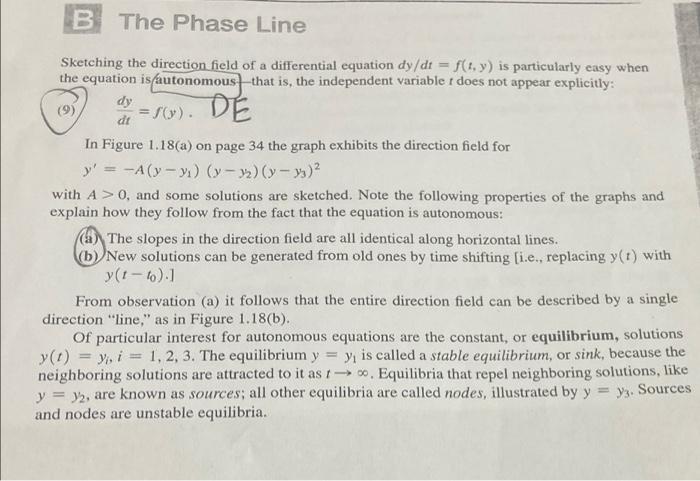
B The Phase Line Sketching the direction field of a differential equation dy/dt = f(t, y) is particularly easy when the equation is autonomous that is, the independent variable r does not appear explicitly: dy (9) = f(y). DE dt In Figure 1.18(a) on page 34 the graph exhibits the direction field for y' = -A(y-1) (x-2)(y-33)² with A> 0, and some solutions are sketched. Note the following properties of the graphs and explain how they follow from the fact that the equation is autonomous: O (a) The slopes in the direction field are all identical along horizontal lines. (b) New solutions can be generated from old ones by time shifting [i.e., replacing y(t) with y(t-to).] From observation (a) it follows that the entire direction field can be described by a single direction "line," as in Figure 1.18(b). Of particular interest for autonomous equations are the constant, or equilibrium, solutions y(t) = y, i = 1, 2, 3. The equilibrium y = y, is called a stable equilibrium, or sink, because the neighboring solutions are attracted to it as →∞. Equilibria that repel neighboring solutions, like y = y2, are known as sources; all other equilibria are called nodes, illustrated by y = y3. Sources and nodes are unstable equilibria.