Page 1 of 1
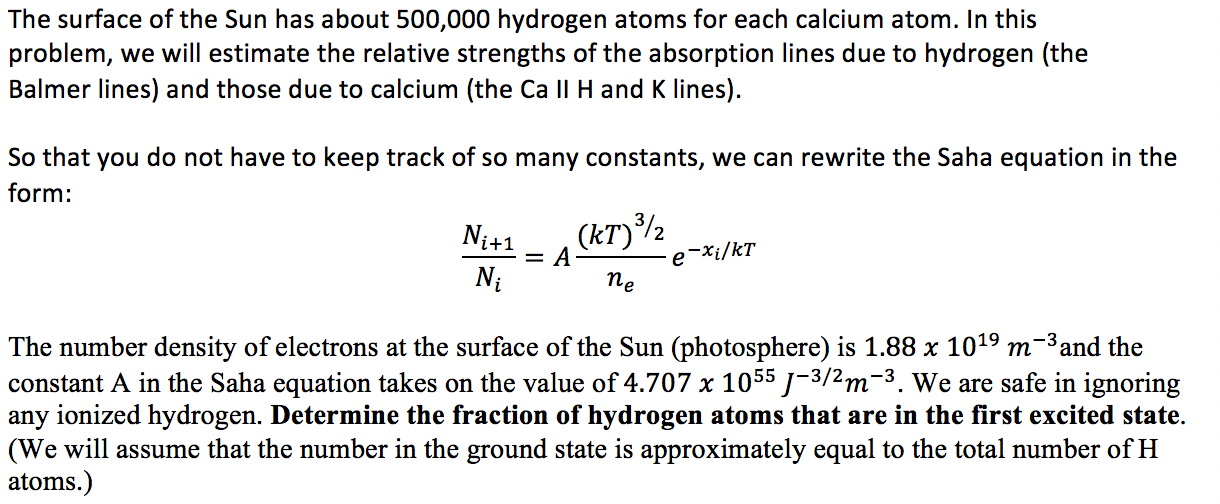
The surface of the Sun has about 500,000 hydrogen atoms for each calcium atom. In this problem, we will estimate the rel
Posted: Mon May 02, 2022 5:20 pm
by answerhappygod
- The Surface Of The Sun Has About 500 000 Hydrogen Atoms For Each Calcium Atom In This Problem We Will Estimate The Rel 1 (247.81 KiB) Viewed 36 times
The surface of the Sun has about 500,000 hydrogen atoms for each calcium atom. In this problem, we will estimate the relative strengths of the absorption lines due to hydrogen (the Balmer lines) and those due to calcium (the Ca II H and K lines). So that you do not have to keep track of so many constants, we can rewrite the Saha equation in the form: Ni+1 (KT) ³/2 = A e-xi/kT Ni ne The number density of electrons at the surface of the Sun (photosphere) is 1.88 x 10¹⁹ m-³ and the constant A in the Saha equation takes on the value of 4.707 x 1055 J-3/2m-³. We are safe in ignoring any ionized hydrogen. Determine the fraction of hydrogen atoms that are in the first excited state. (We will assume that the number in the ground state is approximately equal to the total number of H atoms.)