Page 1 of 1
5. Amber (n = 1.546) is a transparent brown-yellow fossil resin. An insect, trapped and preserved within the amber, appe
Posted: Mon May 02, 2022 5:18 pm
by answerhappygod
- 5 Amber N 1 546 Is A Transparent Brown Yellow Fossil Resin An Insect Trapped And Preserved Within The Amber Appe 1 (38.06 KiB) Viewed 23 times
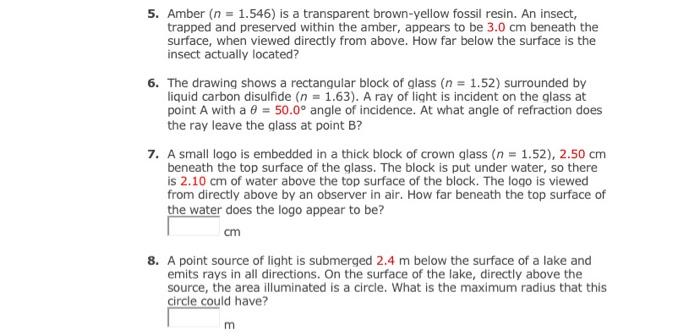
5. Amber (n = 1.546) is a transparent brown-yellow fossil resin. An insect, trapped and preserved within the amber, appears to be 3.0 cm beneath the surface, when viewed directly from above. How far below the surface is the insect actually located? 6. The drawing shows a rectangular block of glass (n = 1.52) surrounded by liquid carbon disulfide (n = 1.63). A ray of light is incident on the glass at point A with a 8 = 50.0° angle of incidence. At what angle of refraction does the ray leave the glass at point B? 7. A small logo is embedded in a thick block of crown glass (n = 1.52), 2.50 cm beneath the top surface of the glass. The block is put under water, so there is 2.10 cm of water above the top surface of the block. The logo is viewed from directly above by an observer in air. How far beneath the top surface of the water does the logo appear to be? cm 8. A point source of light is submerged 2.4 m below the surface of a lake and emits rays in all directions. On the surface of the lake, directly above the source, the area illuminated is a circle. What is the maximum radius that this circle could have? m