Page 1 of 1
Problem 2.21 The gaussian wave packet. A free particle has the initial wave function (x,0) = Ae-ax? where A and a are (r
Posted: Mon May 02, 2022 5:18 pm
by answerhappygod
- Problem 2 21 The Gaussian Wave Packet A Free Particle Has The Initial Wave Function X 0 Ae Ax Where A And A Are R 1 (96.1 KiB) Viewed 24 times
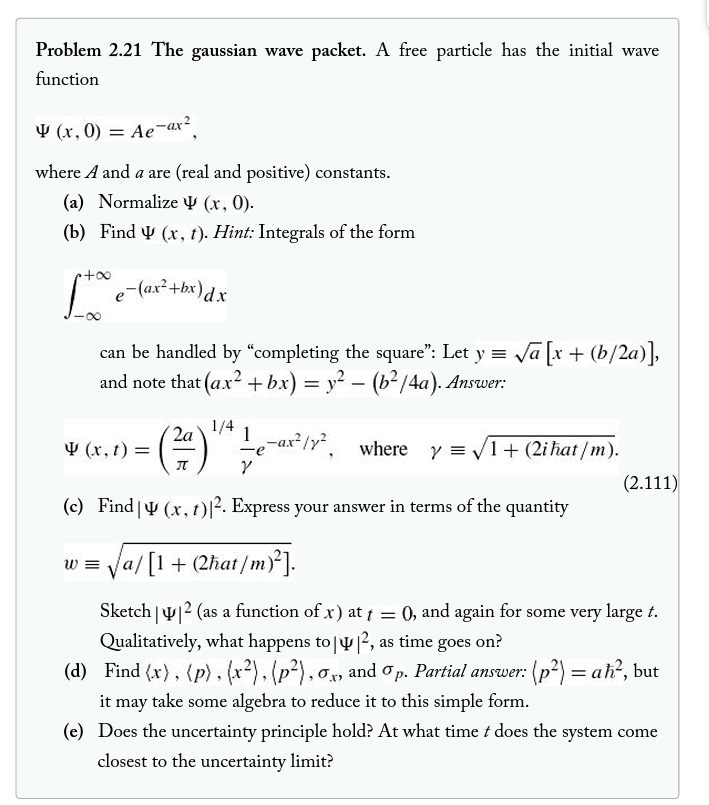
Problem 2.21 The gaussian wave packet. A free particle has the initial wave function (x,0) = Ae-ax? where A and a are (real and positive) constants. (a) Normalize V (x, 0). (b) Find V (x, t). Hint: Integrals of the form [**e-les? e-(ax²+bx) dx can be handled by “completing the square”: Let y = Va [x +(b/2a)], and note that (ax? +bx) = y2 – (62/4a). Answer: = 2a 1/4 1 V (x, t) = e-ax? /v?, where y = /1+ (2ihat /m). V1 + Y (2.111) (c) Find | ¥ (x, t)/2. Express your answer in terms of the quantity (19) -e л = w = Va/ [1 + (2ħat/m)?]. Sketch | ¥12 (as a function of x) at t = 0, and again for some very large t. Qualitatively, what happens to y 12, as time goes on? (d) Find (x), (p), (-2), (p?), ox, and 0 p. Partial answer: (p²) = ah?, but it may take some algebra to reduce it to this simple form. (e) Does the uncertainty principle hold? At what time t does the system come closest to the uncertainty limit?