Page 1 of 1
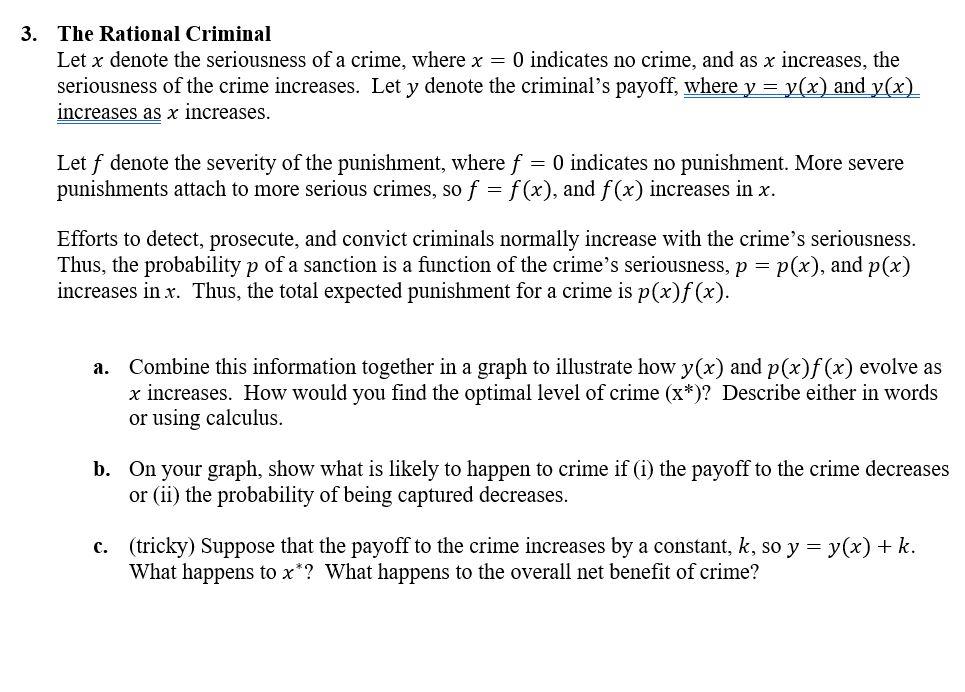
3. The Rational Criminal Let x denote the seriousness of a crime, where x = 0 indicates no crime, and as x increases, th
Posted: Mon May 02, 2022 5:05 pm
by answerhappygod
- 3 The Rational Criminal Let X Denote The Seriousness Of A Crime Where X 0 Indicates No Crime And As X Increases Th 1 (112.79 KiB) Viewed 36 times
3. The Rational Criminal Let x denote the seriousness of a crime, where x = 0 indicates no crime, and as x increases, the seriousness of the crime increases. Let y denote the criminal's payoff, where y = y(x) and y(x) increases as x increases. Let f denote the severity of the punishment, where f = 0 indicates no punishment. More severe punishments attach to more serious crimes, so f = f(x), and f(x) increases in x. = Efforts to detect, prosecute, and convict criminals normally increase with the crime's seriousness. Thus, the probability p of a sanction is a function of the crime's seriousness, p = p(x), and p(x) increases in x. Thus, the total expected punishment for a crime is p(x)f(x). a. Combine this information together in a graph to illustrate how y(x) and p(x)f(x) evolve as x increases. How would you find the optimal level of crime (x*)? Describe either in words or using calculus. b. On your graph, show what is likely to happen to crime if (i) the payoff to the crime decreases or (ii) the probability of being captured decreases. c. (tricky) Suppose that the payoff to the crime increases by a constant, k, so y = y(x) + k. What happens to x*? What happens to the overall net benefit of crime?