Page 1 of 1
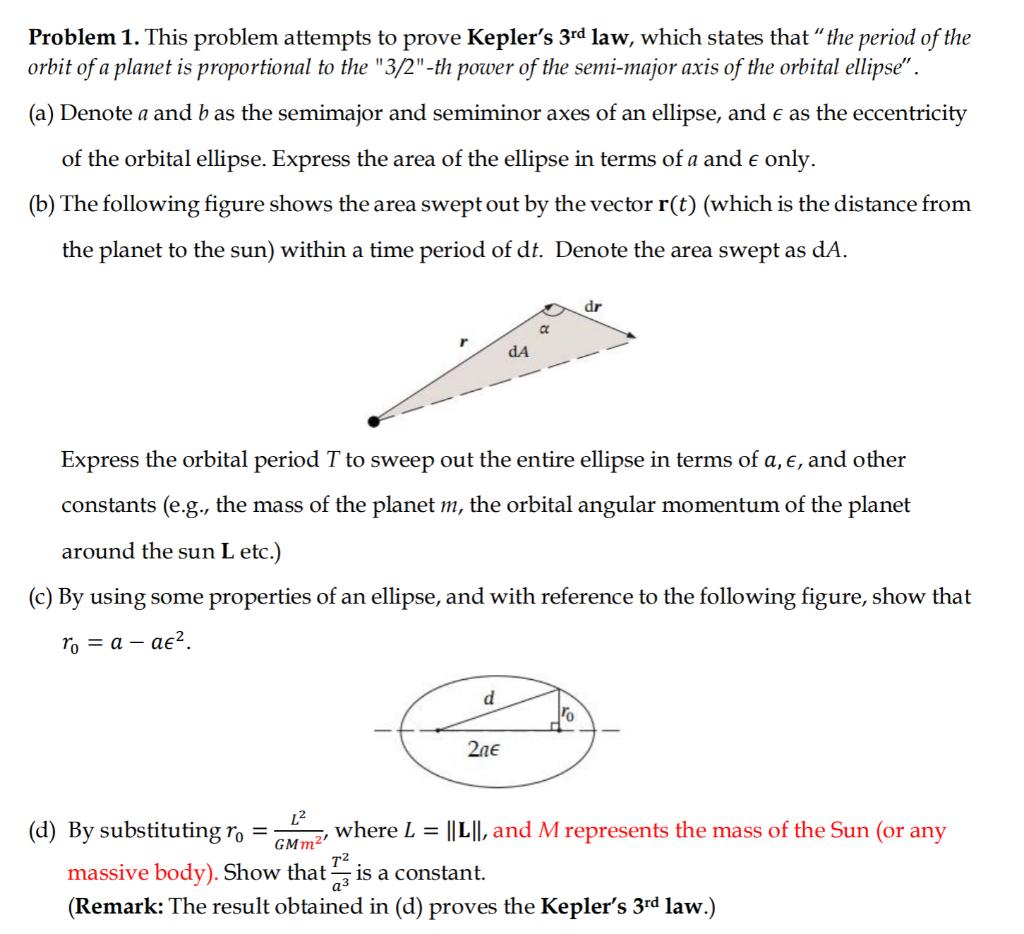
Problem 1. This problem attempts to prove Kepler's 3rd law, which states that “the period of the orbit of a planet is pr
Posted: Mon May 02, 2022 4:47 pm
by answerhappygod
- Problem 1 This Problem Attempts To Prove Kepler S 3rd Law Which States That The Period Of The Orbit Of A Planet Is Pr 1 (110.74 KiB) Viewed 26 times
Problem 1. This problem attempts to prove Kepler's 3rd law, which states that “the period of the orbit of a planet is proportional to the "3/2"-th power of the semi-major axis of the orbital ellipse". (a) Denote a and b as the semimajor and semiminor axes of an ellipse, and e as the eccentricity of the orbital ellipse. Express the area of the ellipse in terms of a and e only. (b) The following figure shows the area swept out by the vector r(t) (which is the distance from the planet to the sun) within a time period of dt. Denote the area swept as dA. dr da Express the orbital period T to sweep out the entire ellipse in terms of a, e, and other constants (e.g., the mass of the planet m, the orbital angular momentum of the planet around the sun L etc.) (c) By using some properties of an ellipse, and with reference to the following figure, show that ro = a - ae? d l'o 21€ L2 (d) By substituting ro where L = ||L||, and M represents the mass of the Sun (or any massive body). Show that is a constant. (Remark: The result obtained in (d) proves the Kepler's 3rd law.) GMm2' 12 a3