Page 1 of 1
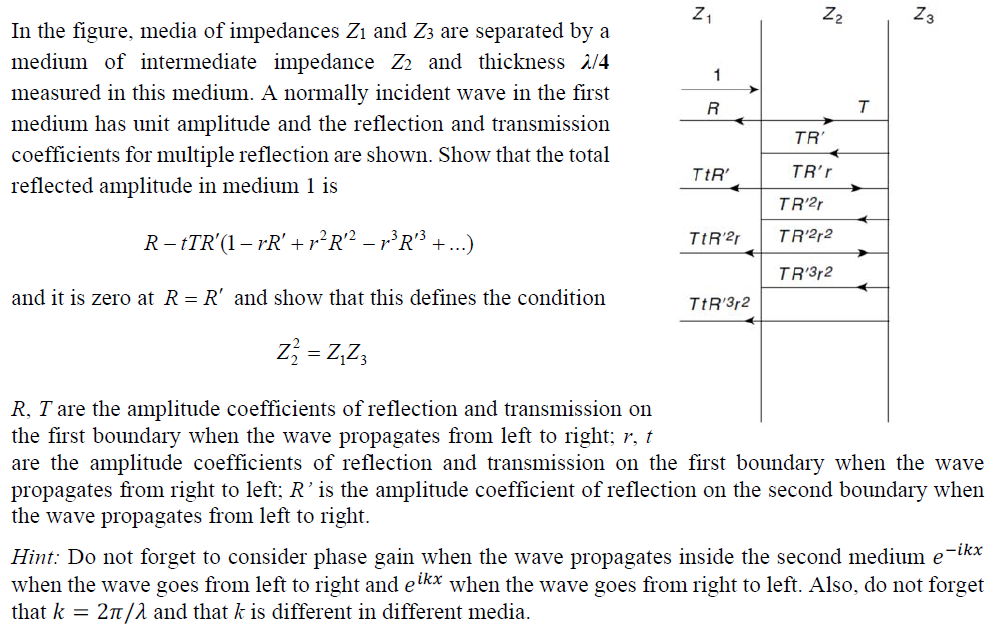
Z Z2 Z3 1 In the figure, media of impedances Zi and Z3 are separated by a medium of intermediate impedance Z2 and thickn
Posted: Mon May 02, 2022 4:32 pm
by answerhappygod
- Z Z2 Z3 1 In The Figure Media Of Impedances Zi And Z3 Are Separated By A Medium Of Intermediate Impedance Z2 And Thickn 1 (113.78 KiB) Viewed 22 times
Z Z2 Z3 1 In the figure, media of impedances Zi and Z3 are separated by a medium of intermediate impedance Z2 and thickness 2/4 measured in this medium. A normally incident wave in the first medium has unit amplitude and the reflection and transmission coefficients for multiple reflection are shown. Show that the total reflected amplitude in medium 1 is R ។ TR TIR' TR'r TR21 R-TR'(1 – rR' +r+R'2 – rR'3 + ...) TER21 IR202 TR32 and it is zero at R=R' and show that this defines the condition TER'3r2 zz = 2,23 R, T are the amplitude coefficients of reflection and transmission on the first boundary when the wave propagates from left to right; r, t are the amplitude coefficients of reflection and tra nission on the first boundary when the wave propagates from right to left; R' is the amplitude coefficient of reflection on the second boundary when the wave propagates from left to right. Hint: Do not forget to consider phase gain when the wave propagates inside the second medium e-ikx when the wave goes from left to right and eikx when the wave goes from right to left. Also, do not forget that k = 21/1 and that k is different in different media.