Page 1 of 1
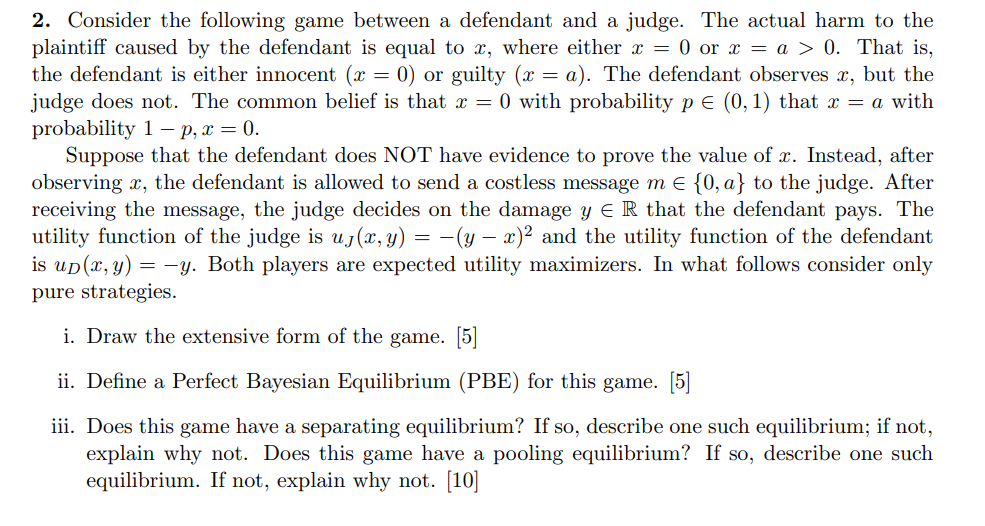
= 2. Consider the following game between a defendant and a judge. The actual harm to the plaintiff caused by the defenda
Posted: Mon May 02, 2022 4:19 pm
by answerhappygod
- 2 Consider The Following Game Between A Defendant And A Judge The Actual Harm To The Plaintiff Caused By The Defenda 1 (160.17 KiB) Viewed 31 times
= 2. Consider the following game between a defendant and a judge. The actual harm to the plaintiff caused by the defendant is equal to x, where either x = 0 or x = a > 0. That is, the defendant is either innocent (x = 0) or guilty (x = a). The defendant observes x, but the judge does not. The common belief is that x = 0) with probability pe (0,1) that x = a with probability 1 – p, x = 0. Suppose that the defendant does NOT have evidence to prove the value of x. Instead, after observing x, the defendant is allowed to send a costless message me {0,a} to the judge. After receiving the message, the judge decides on the damage y E R that the defendant pays. The utility function of the judge is uj(x, y) = -(y – x)2 and the utility function of the defendant is up(x, y) = -y. Both players are expected utility maximizers. In what follows consider only pure strategies. i. Draw the extensive form of the game. [5] ii. Define a Perfect Bayesian Equilibrium (PBE) for this game. [5] iii. Does this game have a separating equilibrium? If so, describe one such equilibrium; if not, explain why not. Does this game have a pooling equilibrium? If so, describe one such equilibrium. If not, explain why not. [10]