Page 1 of 1
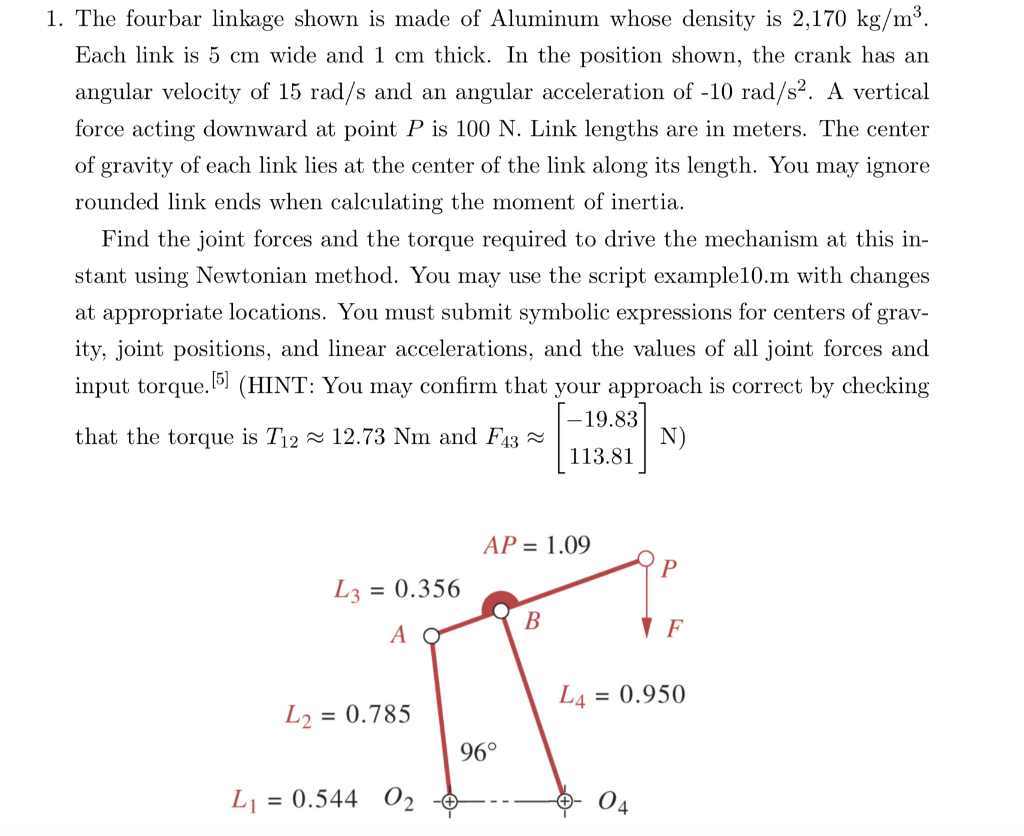
1. The fourbar linkage shown is made of Aluminum whose density is 2,170 kg/m3. Each link is 5 cm wide and 1 cm thick. In
Posted: Mon May 02, 2022 3:49 pm
by answerhappygod
- 1 The Fourbar Linkage Shown Is Made Of Aluminum Whose Density Is 2 170 Kg M3 Each Link Is 5 Cm Wide And 1 Cm Thick In 1 (199.37 KiB) Viewed 44 times

- 1 The Fourbar Linkage Shown Is Made Of Aluminum Whose Density Is 2 170 Kg M3 Each Link Is 5 Cm Wide And 1 Cm Thick In 2 (43.09 KiB) Viewed 44 times
1. The fourbar linkage shown is made of Aluminum whose density is 2,170 kg/m3. Each link is 5 cm wide and 1 cm thick. In the position shown, the crank has an angular velocity of 15 rad/s and an angular acceleration of -10 rad/s2. A vertical force acting downward at point P is 100 N. Link lengths are in meters. The center of gravity of each link lies at the center of the link along its length. You may ignore rounded link ends when calculating the moment of inertia. Find the joint forces and the torque required to drive the mechanism at this in- stant using Newtonian method. You may use the script example10.m with changes at appropriate locations. You must submit symbolic expressions for centers of grav- ity, joint positions, and linear accelerations, and the values of all joint forces and input torque. 15) (HINT: You may confirm that your approach is correct by checking ] –19.83 that the torque is T12 = 12.73 Nm and F43 → N) 113.81 AP = 1.09 Р L3 = = 0.356 B ΑΟ F L4 = = 0.950 L2 = 0.785 96° L1 = 0.544 02 = 04
2. For the same mechanism calculate the torque required to drive the crank when it is oriented 80° using the energy method (check your calculations by confirming that you get the same value of torque at 96°). You may use the examplell.m script 1