Page 1 of 1
(n) → Fn = PROBLEM 3 Consider the following RFB and IFB rotation sequences. ūcm), e ū"), o Fa Fm → Fb ū“), o ua), Fa Fp
Posted: Mon May 02, 2022 3:23 pm
by answerhappygod
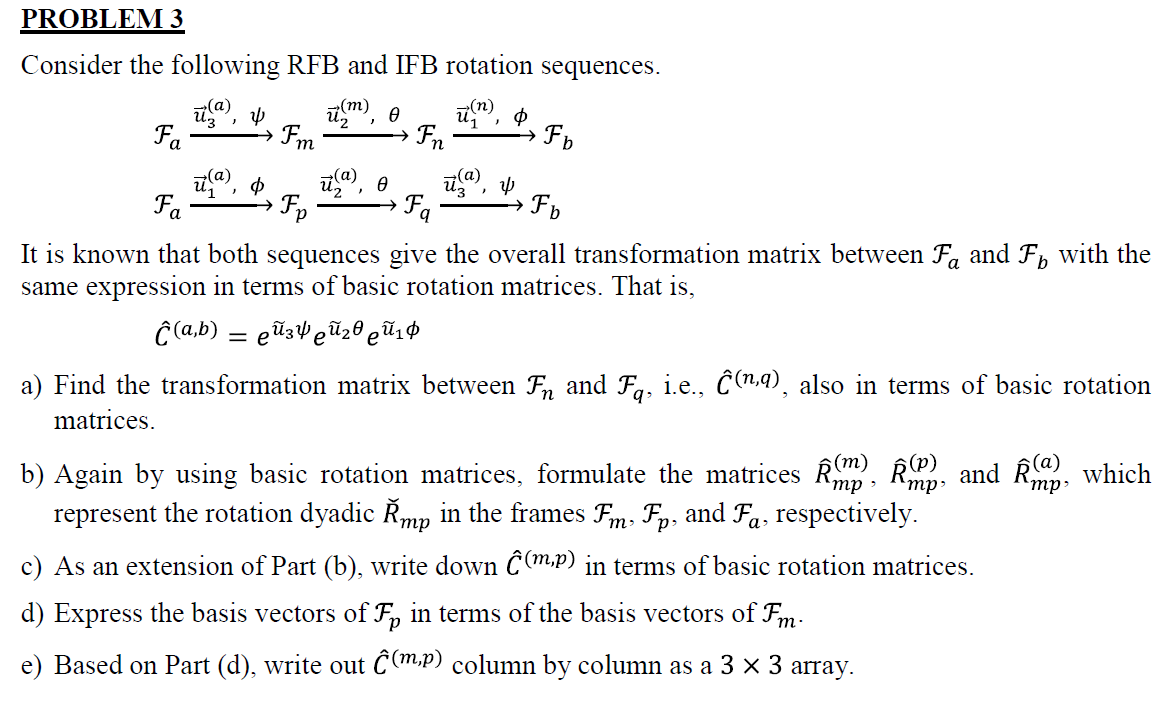
- N Fn Problem 3 Consider The Following Rfb And Ifb Rotation Sequences Ucm E U O Fa Fm Fb U O Ua Fa Fp 1 (81.9 KiB) Viewed 22 times
(n) → Fn = PROBLEM 3 Consider the following RFB and IFB rotation sequences. ūcm), e ū"), o Fa Fm → Fb ū“), o ua), Fa Fp Fq • Fb It is known that both sequences give the overall transformation matrix between Fa and Fp with the same expression in terms of basic rotation matrices. That is, ca,b) = ейҙфей20 ейф a) Find the transformation matrix between Fn and Fq, i.e., Ĉ (1,9), also in terms of basic rotation matrices. () b) Again by using basic rotation matrices, formulate the matrices Rimp, Rimp, and Rimm, which represent the rotation dyadic Řmp in the frames Fm, Fp, and Fa, respectively. c) As an extension of Part (b), write down Ĉ (mp) in terms of basic rotation matrices. d) Express the basis vectors of Fp in terms of the basis vectors of Fm- e) Based on Part (d), write out Ĉ (m.p) column by column as a 3 x 3 array. e ' , тр: