Page 1 of 1
09:30 Wed 27 Apr 80% lear-cu-central-4-prod-toet01ythos.content.blackboardcdn.com University 6. (a) Explain (in your own
Posted: Mon May 02, 2022 3:02 pm
by answerhappygod
- 09 30 Wed 27 Apr 80 Lear Cu Central 4 Prod Toet01ythos Content Blackboardcdn Com University 6 A Explain In Your Own 1 (47.3 KiB) Viewed 35 times
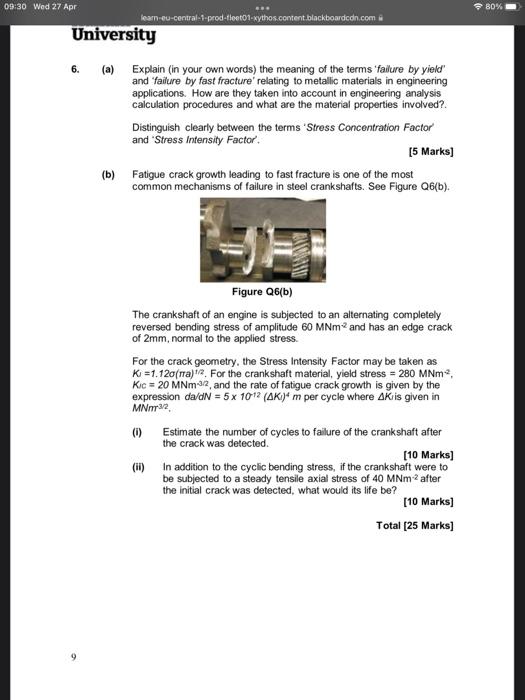
09:30 Wed 27 Apr 80% lear-cu-central-4-prod-toet01ythos.content.blackboardcdn.com University 6. (a) Explain (in your own words) the meaning of the terms failure by yield" and failure by fast fracture relating to metallic materials in engineering applications. How are they taken into account in engineering analysis calculation procedures and what are the material properties involved? Distinguish clearly between the terms 'Stress Concentration Factor and Stress Intensity Factor. [5 Marks) (b) Fatigue crack growth leading to fast fracture is one of the most common mechanisms of failure in steel crankshafts. See Figure Q6(b). Figure 26(b) The crankshaft of an engine is subjected to an alternating completely reversed bending stress of amplitude 60 MNm2 and has an edge crack of 2mm, normal to the applied stress For the crack geometry, the Stress Intensity Factor may be taken as K=1.120(Tra). For the crankshaft material, yield stress = 280 MNm Kc = 20 MNm-32, and the rate of fatigue crack growth is given by the expression da/dN = 5 x 101 (AK) m per cycle where AK is given in MNnt12 (1) Estimate the number of cycles to failure of the crankshaft after the crack was detected. [10 Marks] (H) In addition to the cyclic bending stress, if the crankshaft were to be subjected to a steady tensile axial stress of 40 MNm2 after the initial crack was detected, what would its life be? [10 Marks] Total (25 Marks] 9