Page 1 of 1
2. A television channel with bandwidth 5 MHz is normalized to peak voltages +1 V, and the average power is 30 mW. The si
Posted: Mon May 02, 2022 2:34 pm
by answerhappygod
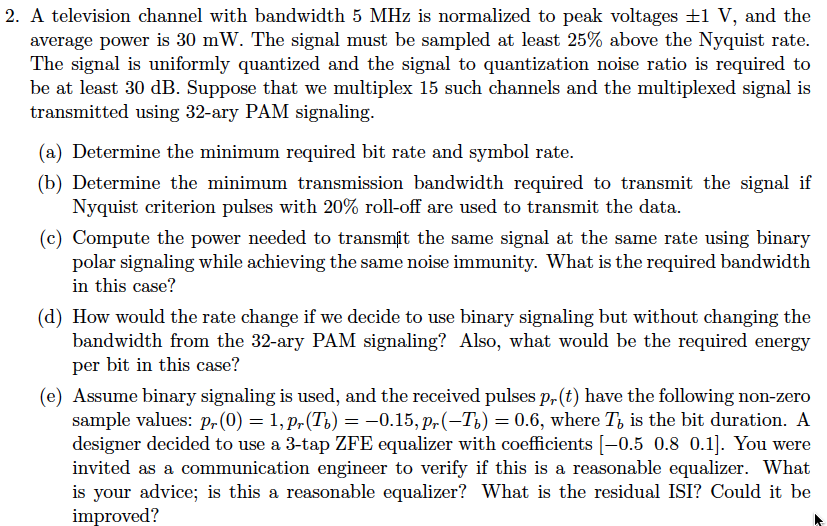
- 2 A Television Channel With Bandwidth 5 Mhz Is Normalized To Peak Voltages 1 V And The Average Power Is 30 Mw The Si 1 (121.45 KiB) Viewed 36 times
2. A television channel with bandwidth 5 MHz is normalized to peak voltages +1 V, and the average power is 30 mW. The signal must be sampled at least 25% above the Nyquist rate. The signal is uniformly quantized and the signal to quantization noise ratio is required to be at least 30 dB. Suppose that we multiplex 15 such channels and the multiplexed signal is transmitted using 32-ary PAM signaling. (a) Determine the minimum required bit rate and symbol rate. (b) Determine the minimum transmission bandwidth required to transmit the signal if Nyquist criterion pulses with 20% roll-off are used to transmit the data. (c) Compute the power needed to transmit the same signal at the same rate using binary polar signaling while achieving the same noise immunity. What is the required bandwidth in this case? (d) How would the rate change if we decide to use binary signaling but without changing the bandwidth from the 32-ary PAM signaling? Also, what would be the required energy per bit in this case? (e) Assume binary signaling is used, and the received pulses pr(t) have the following non-zero sample values: pr(0) = 1, pr(T) = -0.15, pr(-T) = 0.6, where To is the bit duration. A designer decided to use a 3-tap ZFE equalizer with coefficients (-0.5 0.8 0.1]. You were invited as a communication engineer to verify if this is a reasonable equalizer. What is your advice; is this a reasonable equalizer? What is the residual ISI? Could it be improved?