Page 1 of 1
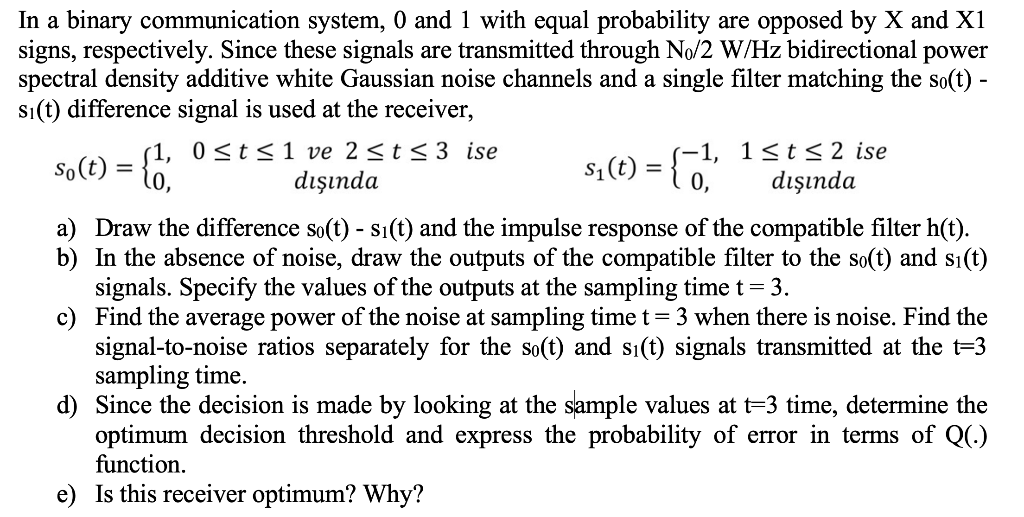
{ = si(t) = {4,1, 15ts2 ise In a binary communication system, 0 and 1 with equal probability are opposed by X and X1 sig
Posted: Mon May 02, 2022 2:33 pm
by answerhappygod
- Si T 4 1 15ts2 Ise In A Binary Communication System 0 And 1 With Equal Probability Are Opposed By X And X1 Sig 1 (153.76 KiB) Viewed 29 times
{ = si(t) = {4,1, 15ts2 ise In a binary communication system, 0 and 1 with equal probability are opposed by X and X1 signs, respectively. Since these signals are transmitted through No/2 W/Hz bidirectional power spectral density additive white Gaussian noise channels and a single filter matching the so(t) - Si(t) difference signal is used at the receiver, 0 <t < 1 ve 2 <t <3 ise so(t) = dışında dışında a) Draw the difference so(t) - sı(t) and the impulse response of the compatible filter h(t). b) In the absence of noise, draw the outputs of the compatible filter to the so(t) and siſt) signals. Specify the values of the outputs at the sampling time t = 3. c) Find the average power of the noise at sampling time t= 3 when there is noise. Find the signal-to-noise ratios separately for the so(t) and si(t) signals transmitted at the t=3 sampling time. d) Since the decision is made by looking at the sample values at t3 time, determine the optimum decision threshold and express the probability of error in terms of QC.) function. e) Is this receiver optimum? Why?