Page 1 of 1
Disk B weighs 56 lb and has a centroidal radius of gyration of 12.5 in. The power unit C consists of a motor M and a dis
Posted: Mon May 02, 2022 11:28 am
by answerhappygod
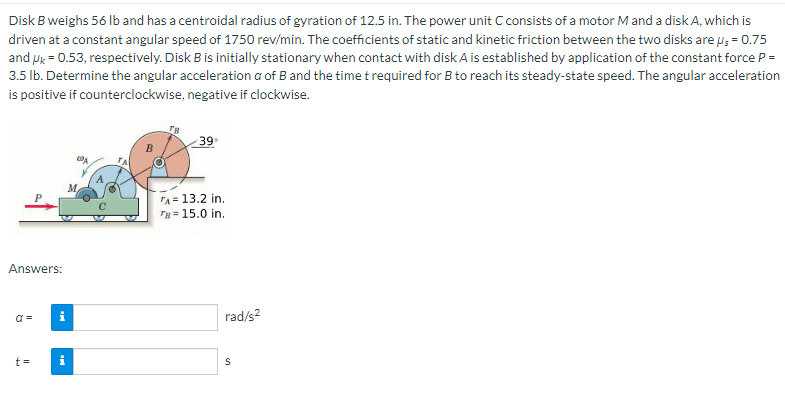
- Disk B Weighs 56 Lb And Has A Centroidal Radius Of Gyration Of 12 5 In The Power Unit C Consists Of A Motor M And A Dis 1 (52.34 KiB) Viewed 30 times
Disk B weighs 56 lb and has a centroidal radius of gyration of 12.5 in. The power unit C consists of a motor M and a disk A, which is driven at a constant angular speed of 1750 rev/min. The coefficients of static and kinetic friction between the two disks are μ = 0.75 and pk = 0.53, respectively. Disk B is initially stationary when contact with disk A is established by application of the constant force P = 3.5 lb. Determine the angular acceleration a of B and the time t required for B to reach its steady-state speed. The angular acceleration is positive if counterclockwise, negative if clockwise. 39 TA= 13.2 in. TB = 15.0 in. Answers: i t = i rad/s² S