Page 1 of 1
Your boss, the chief financial officer (CFO) for Southern Textiles, just handed you the estimated cash flows for two pro
Posted: Mon May 02, 2022 9:18 am
by answerhappygod
- Your Boss The Chief Financial Officer Cfo For Southern Textiles Just Handed You The Estimated Cash Flows For Two Pro 1 (100.91 KiB) Viewed 20 times
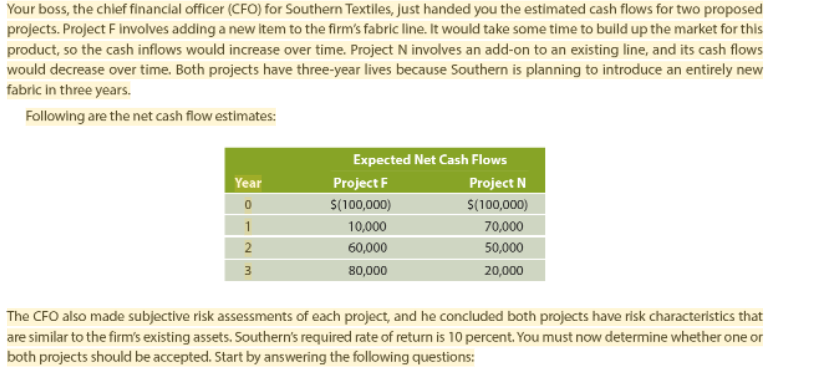
Your boss, the chief financial officer (CFO) for Southern Textiles, just handed you the estimated cash flows for two proposed projects. Project Finvolves adding a new item to the firm's fabric line. It would take some time to build up the market for this product, so the cash inflows would increase over time. Project N involves an add-on to an existing line, and its cash flows would decrease over time. Both projects have three-year lives because Southern is planning to introduce an entirely new fabric in three years. Following are the net cash flow estimates: Year 0 Expected Net Cash Flows Project F Project N S(100,000) S(100,000) 10,000 70,000 60,000 50,000 80,000 20,000 1 2 3 The CFO also made subjective risk assessments of each project, and he concluded both projects have risk characteristics that are similar to the firm's existing assets. Southern's required rate of return is 10 percent. You must now determine whether one or both projects should be accepted. Start by answering the following questions:
a. What is capital budgeting? Are there any similarities between a firm's capital budgeting decisions and an individual's investment decisions? b. What is the difference between independent and mutually exclusive projects? Between projects with conventional cash flows and projects with unconventional cash flows? c. 1. What is the payback period? Find the traditional payback periods for Project F and Project N.