Page 1 of 1
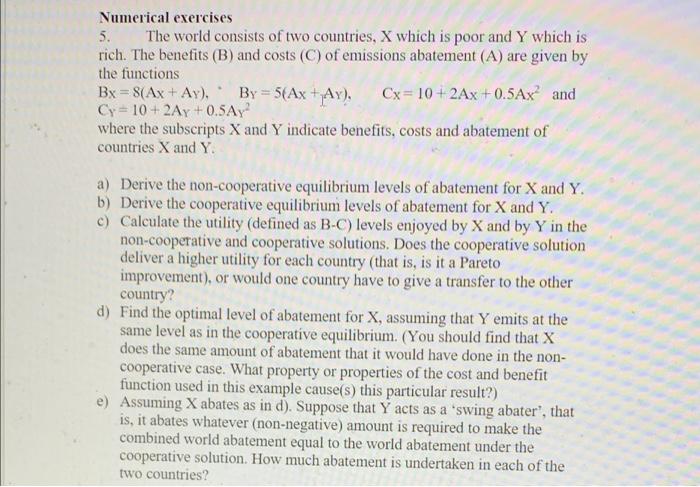
Numerical exercises 5. The world consists of two countries, X which is poor and Y which is rich. The benefits (B) and co
Posted: Mon May 02, 2022 8:39 am
by answerhappygod
- Numerical Exercises 5 The World Consists Of Two Countries X Which Is Poor And Y Which Is Rich The Benefits B And Co 1 (65.23 KiB) Viewed 30 times
Numerical exercises 5. The world consists of two countries, X which is poor and Y which is rich. The benefits (B) and costs (C) of emissions abatement (A) are given by the functions Bx = 8(Ax + Ay). By = 5(Ax +,Ay), Cx=10+2Ax+0.5Ax? and Cy=10+2Ay + 0.5Ay? where the subscripts X and Y indicate benefits, costs and abatement of countries X and Y a) Derive the non-cooperative equilibrium levels of abatement for X and Y. b) Derive the cooperative equilibrium levels of abatement for X and Y. C) Calculate the utility (defined as B-C) levels enjoyed by X and by Y in the non-cooperative and cooperative solutions. Does the cooperative solution deliver a higher utility for each country (that is, is it a Pareto improvement), or would one country have to give a transfer to the other country? d) Find the optimal level of abatement for X, assuming that Y emits at the same level as in the cooperative equilibrium. (You should find that X does the same amount of abatement that it would have done in the non- cooperative case. What property or properties of the cost and benefit function used in this example cause(s) this particular result?) e) Assuming Xabates as in d). Suppose that Y acts as a 'swing abater', that is, it abates whatever (non-negative) amount is required to make the combined world abatement equal to the world abatement under the cooperative solution. How much abatement is undertaken in each of the two countries?