Page 1 of 1
Consider an industry that consists of two firms, A and B. They face a demand curve Q=qa+qB = 14– P, where P is the indus
Posted: Mon May 02, 2022 8:35 am
by answerhappygod
- Consider An Industry That Consists Of Two Firms A And B They Face A Demand Curve Q Qa Qb 14 P Where P Is The Indus 1 (255.39 KiB) Viewed 36 times
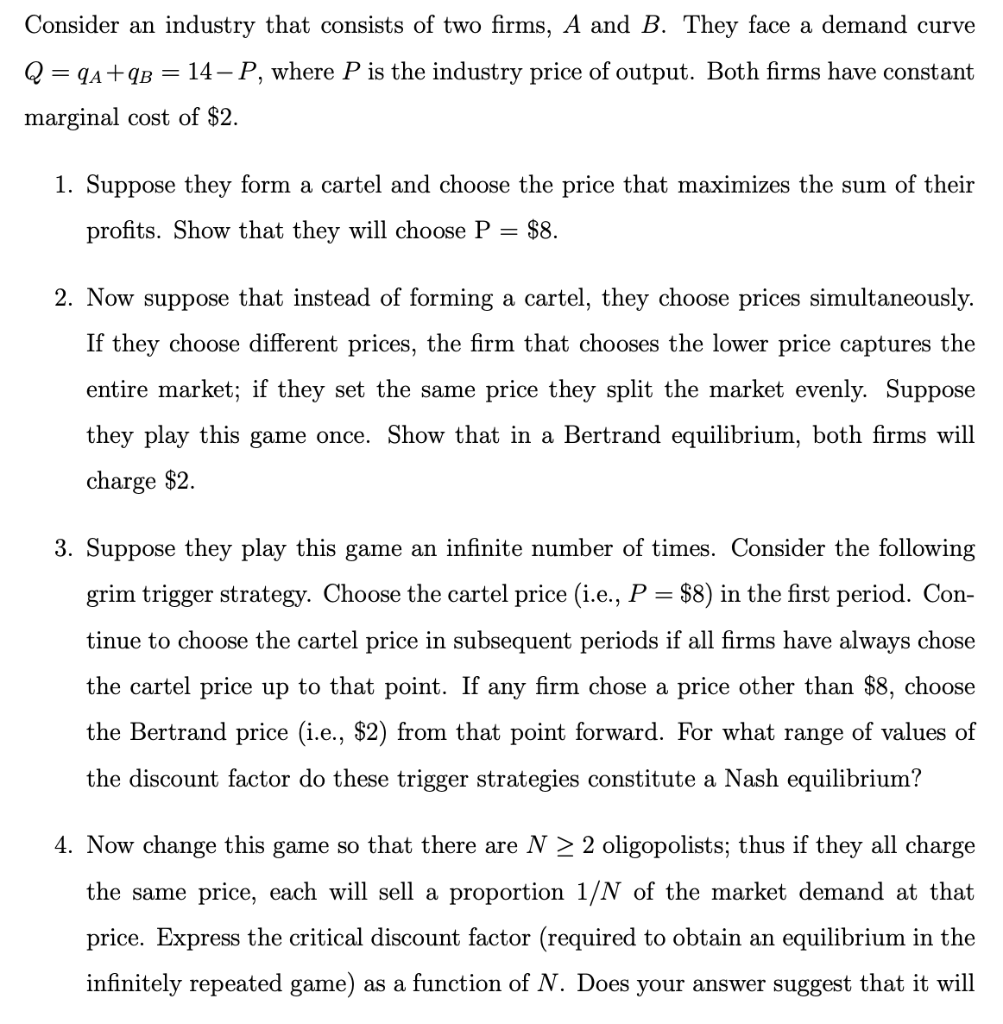
Consider an industry that consists of two firms, A and B. They face a demand curve Q=qa+qB = 14– P, where P is the industry price of output. Both firms have constant marginal cost of $2. 1. Suppose they form a cartel and choose the price that maximizes the sum of their profits. Show that they will choose P = $8. 2. Now suppose that instead of forming a cartel, they choose prices simultaneously. If they choose different prices, the firm that chooses the lower price captures the entire market; if they set the same price they split the market evenly. Suppose they play this game once. Show that in a Bertrand equilibrium, both firms will charge $2. = 3. Suppose they play this game an infinite number of times. Consider the following grim trigger strategy. Choose the cartel price (i.e., P = $8) in the first period. Con- tinue to choose the cartel price in subsequent periods if all firms have always chose the cartel price up to that point. If any firm chose a price other than $8, choose the Bertrand price (i.e., $2) from that point forward. For what range of values of the discount factor do these trigger strategies constitute a Nash equilibrium? 4. Now change this game so that there are N > 2 oligopolists; thus if they all charge the same price, each will sell a proportion 1/N of the market demand at that price. Express the critical discount factor (required to obtain an equilibrium in the infinitely repeated game) as a function of N. Does your answer suggest that it will
be easier to sustain cooperation when N is small or when N is large? What is the intuition behind this result?