Page 1 of 1
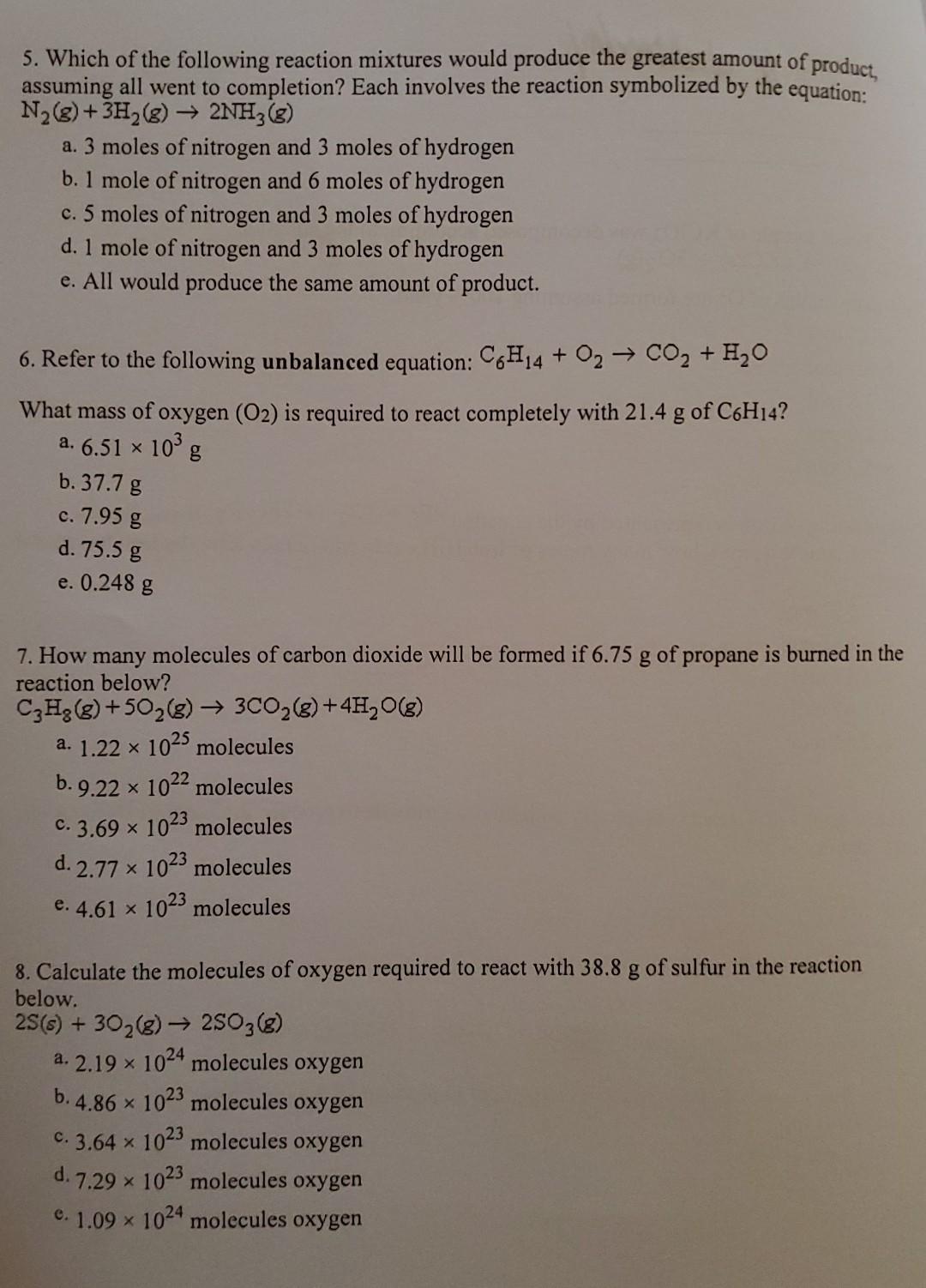
5. Which of the following reaction mixtures would produce the greatest amount of product , assuming all went to completi
Posted: Fri Apr 29, 2022 1:38 pm
by answerhappygod
- 5 Which Of The Following Reaction Mixtures Would Produce The Greatest Amount Of Product Assuming All Went To Completi 1 (138.26 KiB) Viewed 24 times
- 5 Which Of The Following Reaction Mixtures Would Produce The Greatest Amount Of Product Assuming All Went To Completi 2 (71.79 KiB) Viewed 24 times
5. Which of the following reaction mixtures would produce the greatest amount of product , assuming all went to completion? Each involves the reaction symbolized by the equation: N2(g) + 3H2(g) → 2NH3(g) a. 3 moles of nitrogen and 3 moles of hydrogen b. 1 mole of nitrogen and 6 moles of hydrogen c. 5 moles of nitrogen and 3 moles of hydrogen d. 1 mole of nitrogen and 3 moles of hydrogen e. All would produce the same amount of product. 6. Refer to the following unbalanced equation: CH14 + 02 → CO2 + H2O X What mass of oxygen (O2) is required to react completely with 21.4 g of C6H14? a. 6.51 x 10³g b. 37.7 g c. 7.95 g d. 75.5 g e. 0.248 g 7. How many molecules of carbon dioxide will be formed if 6.75 g of propane is burned in the reaction below? C3H2(g) +502(g) → 3C02(g) + 4H2O(g) a. 1.22 x 1025 molecules b.9.22 1022 molecules c. 3.69 1023 molecules d. 2.77 x 10²³ molecules e. 4.61 x 10²³ molecules Х х х 8. Calculate the molecules of oxygen required to react with 38.8 g of sulfur in the reaction g below. 25(s) + 302(g) → 2503(g) a. 2.19 x 1024 molecules oxygen b.4.86 x 1023 molecules oxygen c. 3.64 x 10²³ molecules oxygen d. 7.29 1023 molecules oxygen e. 1.09 x 1024 molecules oxygen х
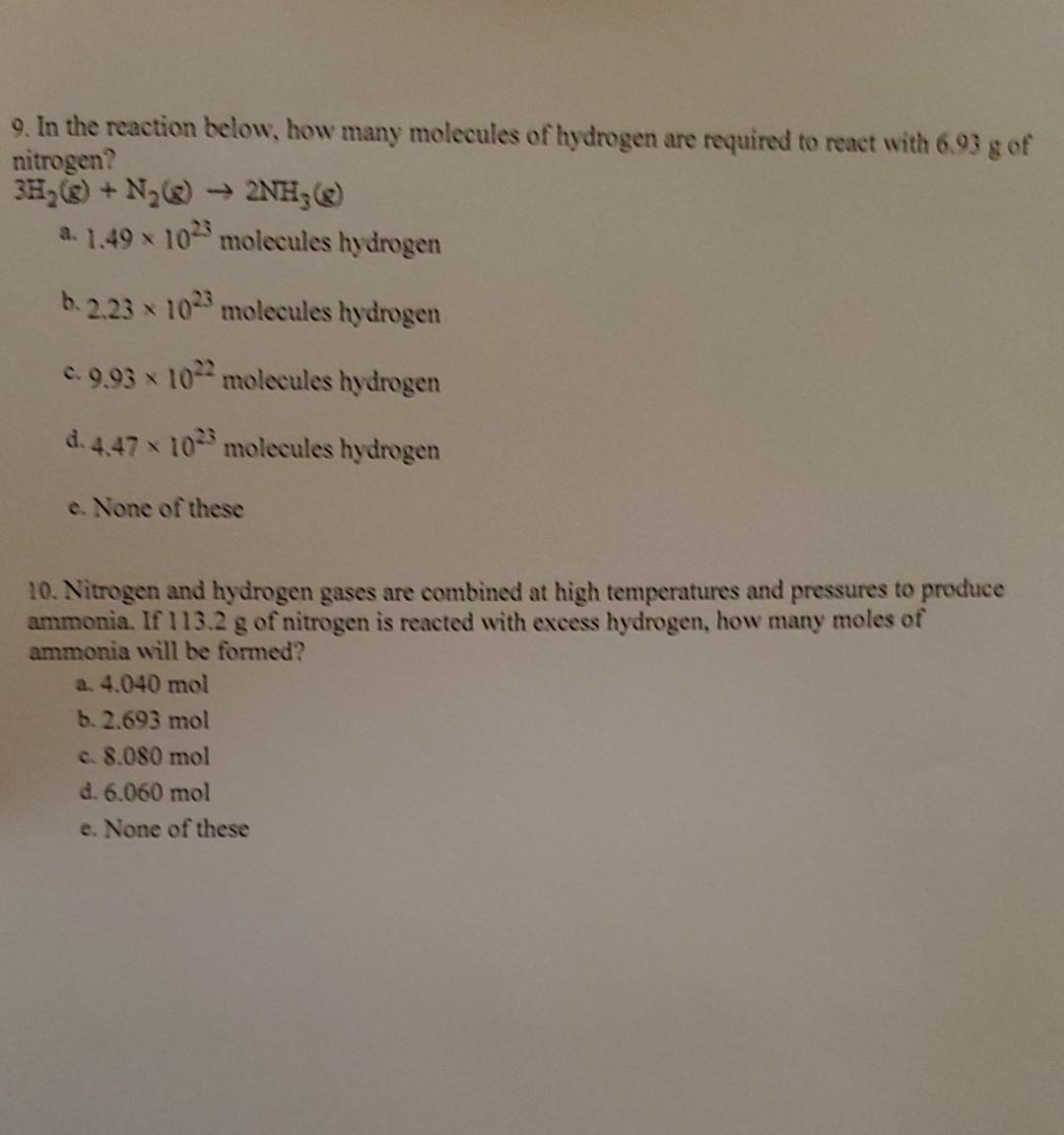
9. In the reaction below, how many molecules of hydrogen are required to react with 693 g of nitrogen? 3H (Ⓡ) + N2 + 2NH3®) a. 1.49 10 molecules hydrogen 1.2.23 10-3 molecules hydrogen c.9.93 102 molecules hydrogen d. 4.47 10molecules hydrogen e. None of these 10. Nitrogen and hydrogen gases are combined at high temperatures and pressures to produce ammonia. If 113.2 g of nitrogen is reacted with excess hydrogen, how many moles of ammonia will be formed? a. 4.040 mol b. 2.693 mol c. 8.080 mol d. 6.060 mol e. None of these