Page 1 of 1
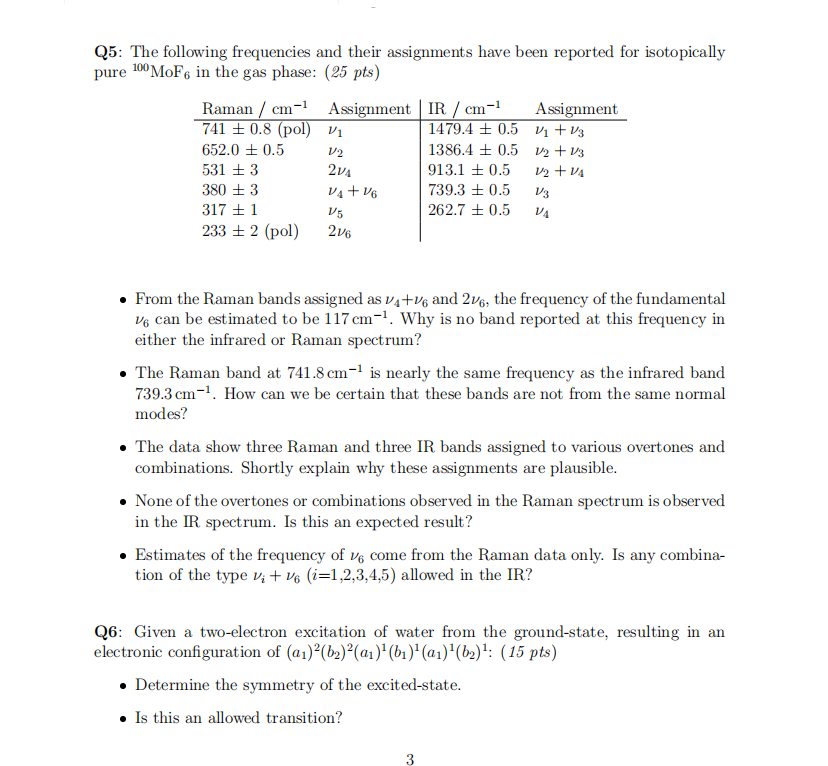
Q5: The following frequencies and their assignments have been reported for isotopically pure 100 MoF6 in the gas phase:
Posted: Fri Apr 29, 2022 1:01 pm
by answerhappygod
- Q5 The Following Frequencies And Their Assignments Have Been Reported For Isotopically Pure 100 Mof6 In The Gas Phase 1 (107.76 KiB) Viewed 24 times
Q5: The following frequencies and their assignments have been reported for isotopically pure 100 MoF6 in the gas phase: (25 pts) Raman / cm- Assignment IR / cm- Assignment 741 + 0.8 (pol) V1 1479.4 + 0.5 V1 + V3 652.0 + 0.5 1386.4 + 0.5 12 +13 531 + 3 2V4 913.1 + 0.5 12 +VA 380 + 3 VA + V6 739.3 + 0.5 V3 317 +1 Vs 262.7 + 0.5 VA 233 + 2 (pol) V2 216 • From the Raman bands assigned as va+ve and 216, the frequency of the fundamental Ve can be estimated to be 117cm-1. Why is no band reported at this frequency in either the infrared or Raman spectrum? • The Raman band at 741.8 cm-- is nearly the same frequency as the infrared band 739.3 cm-?. How can we be certain that these bands are not from the same normal modes? • The data show three Raman and three IR bands assigned to various overtones and combinations. Shortly explain why these assignments are plausible. None of the overtones or combinations observed in the Raman spectrum is observed in the IR spectrum. Is this an expected result? • Estimates of the frequency of ve come from the Raman data only. Is any combina- tion of the type v; + v6 (i=1,2,3,4,5) allowed in the IR? Q6: Given a two-electron excitation of water from the ground-state, resulting in an electronic configuration of (a1) (62)(a1)^(11)(a1) (62)": (15 pts) • Determine the symmetry of the excited-state. Is this an allowed transition? 3