Page 1 of 1
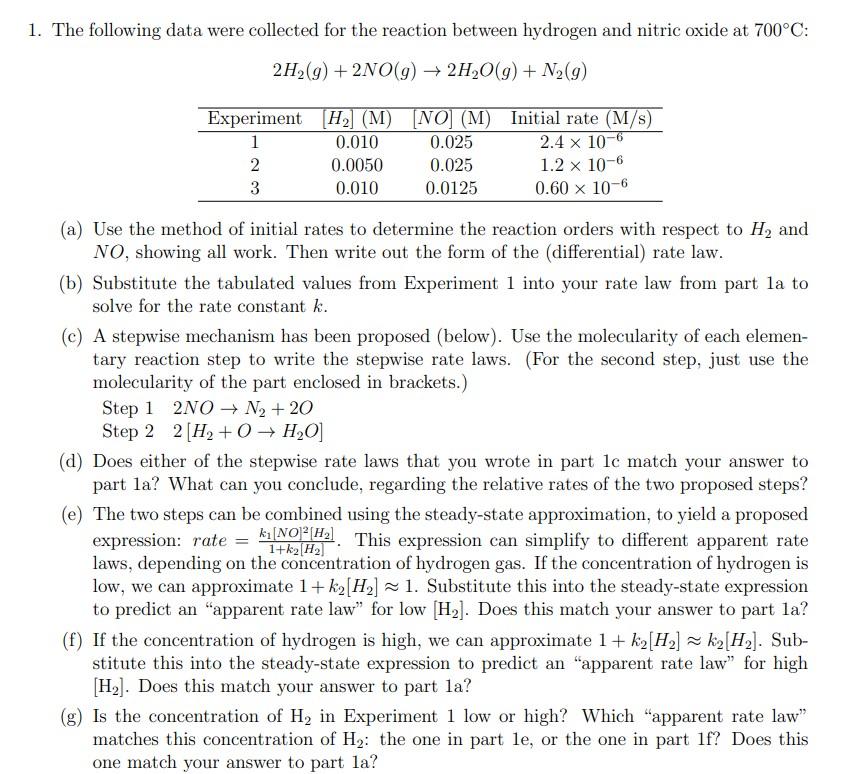
1. The following data were collected for the reaction between hydrogen and nitric oxide at 700°C: 2H2(g) + 2NO(g) + 2H2O
Posted: Fri Apr 29, 2022 12:40 pm
by answerhappygod
- 1 The Following Data Were Collected For The Reaction Between Hydrogen And Nitric Oxide At 700 C 2h2 G 2no G 2h2o 1 (126.84 KiB) Viewed 39 times
1. The following data were collected for the reaction between hydrogen and nitric oxide at 700°C: 2H2(g) + 2NO(g) + 2H2O(g) + N2(9) Experiment (H2] (M) [NO] (M) Initial rate (M/s) 1 0.010 0.025 2.4 x 10⁻⁶ 2 0.0050 0.025 1.2 x 10⁻⁶ 3 0.010 0.0125 0.60 x 10⁻⁶ (a) Use the method of initial rates to determine the reaction orders with respect to H, and NO, showing all work. Then write out the form of the differential) rate law. (b) Substitute the tabulated values from Experiment 1 into your rate law from part la to solve for the rate constant k. (c) A stepwise mechanism has been proposed (below). Use the molecularity of each elemen- tary reaction step to write the stepwise rate laws. (For the second step, just use the molecularity of the part enclosed in brackets.) Step 1 2N0 N2 + 20 Step 2 2 [H2 + 0 + H2O] (d) Does either of the stepwise rate laws that you wrote in part lc match your answer to part la? What can you conclude, regarding the relative rates of the two proposed steps? (e) The two steps can be combined using the steady-state approximation, to yield a proposed expression: rate = ki[NOPH, This expression can simplify to different apparent rate 1+k2H2) laws, depending on the concentration of hydrogen gas. If the concentration of hydrogen is low, we can approximate 1+k2[HQ] -1. Substitute this into the steady-state expression to predict an "apparent rate law” for low [H2). Does this match your answer to part la? (f) If the concentration of hydrogen is high, we can approximate 1+ ka[HQ] – ką[H]. Sub- stitute this into the steady-state expression to predict an "apparent rate law” for high [H2). Does this match your answer to part la? (g) Is the concentration of H, in Experiment 1 low or high? Which "apparent rate law" matches this concentration of Hy: the one in part le, or the one in part 1f? Does this one match your answer to part la?