Page 1 of 1
(a) Use the equation for maximum radial velocity signal (let's call it Vmax) for an edge-on orbit (Equation (5.8)) along
Posted: Fri Apr 29, 2022 12:05 pm
by answerhappygod
- A Use The Equation For Maximum Radial Velocity Signal Let S Call It Vmax For An Edge On Orbit Equation 5 8 Along 1 (107.6 KiB) Viewed 50 times
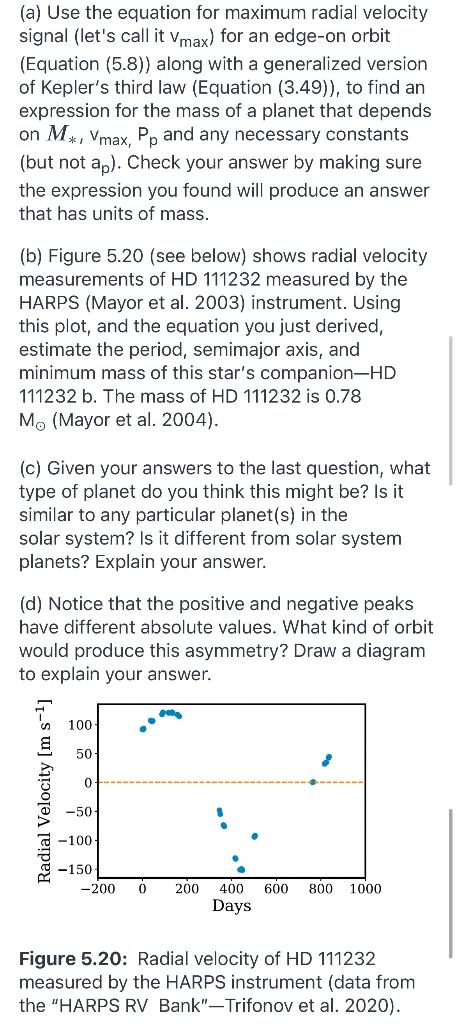
(a) Use the equation for maximum radial velocity signal (let's call it Vmax) for an edge-on orbit (Equation (5.8)) along with a generalized version of Kepler's third law (Equation (3.49)), to find an expression for the mass of a planet that depends on MX, Vmax, Pp and any necessary constants (but not ap). Check your answer by making sure the expression you found will produce an answer that has units of mass. (b) Figure 5.20 (see below) shows radial velocity measurements of HD 111232 measured by the HARPS (Mayor et al. 2003) instrument. Using this plot, and the equation you just derived, estimate the period, semimajor axis, and minimum mass of this star's companion-HD 111232 b. The mass of HD 111232 is 0.78 Mo (Mayor et al. 2004). (c) Given your answers to the last question, what type of planet do you think this might be? Is it similar to any particular planet(s) in the solar system? Is it different from solar system planets? Explain your answer. (d) Notice that the positive and negative peaks have different absolute values. What kind of orbit would produce this asymmetry? Draw a diagram to explain your answer. 100 50 0 Radial Velocity [m s-?] -50 -100 -150 -200 0 200 600 800 1000 400 Days Figure 5.20: Radial velocity of HD 111232 measured by the HARPS instrument (data from the "HARPS RV Bank"-Trifonov et al. 2020).